
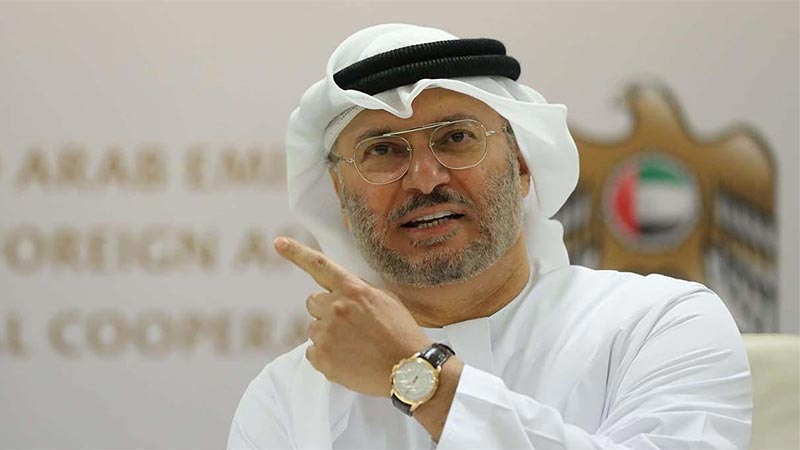
UAE minister ‘very optimistic' as Arab countries end feud with Qatar
DUBAI - UAE Minister of State for Foreign Affairs Anwar Gargash said he was "very optimistic" about the agreement to restore diplomatic ties with Qatar, but added that it will take "a lot of transparency" to rebuild confidence. The UAE, Saudi Arabia, Bahrain and members of the GCC signed the Al-Ula Declaration on January 5 during a summit aimed at resolving the three-year boycott against Qatar. "I'm very optimistic, but of course you always know that following a rift such as the one that we have had, the issue of rebuilding confidence is one that takes time, takes some energy, and takes a lot of transparency," Gargash told CNN's Becky Anderson on Connect the World. "The UAE is willing to put all that in order to build these bridges again and to maintain them, because we think that this is good for the UAE, this is good for the GCC, and indeed, good for Qatar," he said. When asked about the Arab quartet's 13 demands on Qatar from 2017, Gargash said they were considered a "maximalist negotiating position" at the time but today they ended up with "general outlines." "This is something that we have always said—that the 13 demands, at the time, were considered what I would call a maximalist negotiating position. I think what we end up today with is are general outlines that basically govern relations between states that are party to the same organization, the GCC," Gargash said. "These are what I would call general outlines of how this relationship will move on, and I think we're very satisfied with this and we want to build on it."Here's the transcript of the interview
Becky Anderson, CNN: Well, here to talk more about that new beginning and what it means for this wider region is the author of that tweet, his Excellency, Dr. Anwar Gargash. It's good to have you. I know you are just back from that signing ceremony, in what was a remarkable setting, Dr. Gargash. It has to -- has to be said. What does this mean practically, sir? Anwar Gargash, Minister of State for Foreign Affairs, UAE: Well, Becky, thank you for hosting me. I think first of all, I have to say that we are very optimistic, I think the first practical thing that it means politically and geo-strategically, that the riff that has, you know, consumed the GCC over the last three, three and half years, has been resolved, beginning a process of healing. So, I think it means a lot in terms of the ability of the GCC to function fully in the coming period. And to function fully means that politically it will reemerge as the geo-strategic bloc of countries that it has always been. So, I would say that is the first thing in terms of political and geopolitical. The deal basically addresses a lot of the concerns of the various states with regards of how their relationships should be and should be conducted. I think on other planes it is a deal that will end a lot of the measures that were taken during this period, measures that have affected business, that affected investment, have affected also movement of people within these countries and, of course, Egypt airlines over-flights and so on, so forth. So, the deal has important political ramifications in a really healing rift within the GCC House and I think this will sort of translate itself into a more active and unified GCC geo-strategically. And as I said, also, in other areas to do with business and to do with -- Anderson: Right. (CROSSTALK) Gargash: -- of people and others we will see, you know, a return to normal. Anderson: Dr. Gargash, Qatar was accused by the quartet of which of course UAE was a member, amongst other things, of provocative and hostile behavior, of sponsoring or supporting terrorism and of interfering in the affairs of neighboring countries. Are you then confident that these key issues have been resolved? Gargash: Well, again, you know, we have placed our confidence in the Saudis in leading this process of negotiations, and I think that our confidence is justified and clearly, also the idea basically is to try and the set the rules of non-interference on agreeing on issues that affect all of us, including extremism and terrorism, which are part and parcel of the deal. We are confident. We are looking forward enthusiastically, but, you know, as you always know the proof is in the pudding, and we hope that we will work together moving forward to ensure that such disruptive rift, one that we've all gone through, should not reoccur through transparency and through working together to address these issues. Anderson: Well, what happened to the list of 13 demands agreed on by the quartet, including, for example, shutting down Al Jazeera, closing a Turkish military base and scaling back Doha's cooperation with Iran? Have those demands now been dropped, sir? Gargash: Well, again, you know, my view and this is something that we have always said, that the 13 demands at the time were considered what I would call a maximalist negotiating position. I think what we end up to deal with is general outlines that basically govern relations between states that our party – to the same organization, the GCC, and in the case of Egypt, also a member of the Arab League. So these are what I would call general outlines of how this relationship will move on, and I think we're very satisfied with this. And we want to build on it, and we want to look to the future building on this, and ensuring that in this very turbulent region that the GCC is more solid -- Anderson: Right. Gargash: -- more unified, and looking towards the future in unison. Anderson: You started on a very optimistic note, and I hear that. Would it though, sir, be fair to say that while the diplomatic crisis is resolved, tensions with Qatar – at least from the UAE's perspective do remain? You say the proof is in the pudding, as it were. I mean, this is something that you will want to see improve over a period of time, is it? Gargash: Well, I hope not. But I think I have to be realistic, following such a long rift, it is, I think only natural that we are able to build confidence among the four states of Qatar as we move forward. I think we have a good agreement, we have a good framework, and I think also we're already working as we speak now on implementation. And I think that we will see implementation quite quickly in many of the measures that we're taking. I have to be quite honest, I'm very optimistic, but of course, you always know that following a rift such as the one that we have had, the issue of rebuilding confidence is one that takes time, takes some energy, and takes a lot of transparency, and the UAE is willing to put all that in order to build these bridges again and to maintain them, because we think that this is good for the UAE, this is good for the GCC, and indeed, good for Qatar. Anderson: Donald Trump's son-in-law and senior advisor, Jared Kushner, was present at the ceremony today having negotiated this agreement, as we understand it. There is no doubt that this dispute has complicated Washington's policy on containing Iran, and it is clear when you listen to the Crown Prince Mohammed bin Salman, today that a united gulf front would certainly help with regard Iran. What is your message to Tehran today, sir? Gargash: Well, I think the first thing is to acknowledge the role that was played by Kuwait and indeed the role that was played by Washington in arriving at this point. It has not been an easy process, but indeed a successful one. But I think the important thing that the GCC, today from Al-Ula is sending, it's a message of unity, and it's a message where the GCC seeks what I would say, peaceful orientation with all its neighbors. But at the same time, refute any sort of interference in its affairs. This is also a clause that was in the GCC statement today that came out of Al-Ula. So, clearly, I think we are quite honest about what we want to see. We want to see a region that is more stable, we want to stay away from threatening language, threatening action. And I think this is the sort of message that we are sending today. I think the main thing that emerges really out of Al-Ula is, number one, is capable Saudi leadership, and at the same time, I would say a united GCC trying to sort of orient itself as one geo-strategic grouping, as it should. Anderson: I just want to – I just want to reiterate or repeat what the Crown Prince Mohammed bin Salman said today. He said, "we are in dire need of -- to unite efforts to advance our region and face the challenges that surround us." He went on to say, "especially with the threats posed by the Iranian regime's nuclear program, its ballistic missile program and its destructive sabotage projects that are adopted by Iran's terrorists and sectarian proxies." This is a view that you share, sir, correct? Gargash: Well, again, I think this is, you know, a long-stated position of all the countries of the GCC. There is real concern with the nuclear program, there's a real concern with the missile program, and there is a real concern with the Iranian regional policy. I think this is a stated view. But at the same time, I think the GCC is mature in calling for political solutions to these issues, and I think this something where we as a group emerge stronger today following the declaration Al-Ula. Anderson: Sir, do you expect to have a seat at the table in any negotiations that the incoming Biden administration will have with Tehran on any future nuclear deal at this point? Gargash: Well, again, Becky, I think it's premature, because we really don't have a very clear idea on how things will develop. But I think a reasonable voice at any sort of conquer with regards to the nuclear deal or beyond has always been also a stated position from the region. But I think for us, we are really following many of the various statements from Tehran, from Washington, from European capitals, and especially, really, from the Biden administration, to sort of see the lay of the land as we move -- as we move forward. Having said that, I think the absence of a regional voice, an Arab regional voice, in -- in the original JCPOA is something that need to be amended, and I think time has shown that it's very much on point. Anderson: There will be those, sir, who will suggest that today's agreement, brokered as it was by Jared Kushner, is a cosmetic fix by Riyadh and others ahead of this new Biden administration which, to be frank, has made it quite clear that is looking both to reassess its relationship with Saudi Arabia and to have a better relationship with Iran going forward. What do you say to those who suggest this is a cosmetic fix, a fig leaf as it were, by the kingdom? Gargash: Look, I think -- I think the first thing to say is that the priority and the Al-UIa declaration is us, the GCC. And I think the first thing is to try and heal a rift within the same organization, within the same group of countries that share, you know, history, share a lot of familiar relationships, and so on and so forth -- economies and so on and so forth. So, I would say that the main focus of healing this rift is an internal GCC for our focus. But, I -- and -- and it has taken long, and I would come and say that the current all-society effort in reaching out to arrive at today's arrangement, you know, representing us and other countries has not been something that was done in weeks. It's really taken a long period of time in order for us to arrive at this point. So, my argument would be that any other external concentrations are second, but I think the major, major concentration for the optimism that we see today is very much a GCC reading of where we should be, what we should concentrate on, how difficult the region is, and how do we deal with it. Now, the issue of, is this cosmetic or no? We have to work at making this deal quite waterproof in many ways. And speaking on behalf of the UAE, we have every intention of ensuring that the Al-Ula declaration is a success, because we feel that it is in the interest of the UAE, and we feel that it is in the interest of the region. Anderson: With that, we'll leave it there. We thank you very much indeed for joining us out of the flight from Saudi Arabia. ICA/CNN/Expat MediaFor all the latest news from the UAE and the world, follow us on Facebook, Twitter and Instagram and subscribe to our YouTube pageJTNDJTIxLS0lMjBDb2RlcyUyMGJ5JTIwSFRNTC5hbSUyMC0tJTNFJTBBJTBBJTNDJTIxLS0lMjBDU1MlMjBDb2RlJTIwLS0lM0UlMEElM0NzdHlsZSUyMHR5cGUlM0QlMjJ0ZXh0JTJGY3NzJTIyJTIwc2NvcGVkJTNFJTBBYS5HZW5lcmF0ZWRMaW5rJTNBbGluayUyMCU3QiUwQWZvbnQtc2l6ZSUzQThweCUzQnRleHQtZGVjb3JhdGlvbiUzQW5vbmUlM0Jjb2xvciUzQSUyMzAwMDAzMyUzQmJhY2tncm91bmQtY29sb3IlM0ElMjNmOWY1ZjUlM0IlMEElN0QlMEFhLkdlbmVyYXRlZExpbmslM0F2aXNpdGVkJTIwJTdCJTBBY29sb3IlM0ElMjMwMDAwMzMlM0IlMEElN0QlMEFhLkdlbmVyYXRlZExpbmslM0Fob3ZlciUyMCU3QiUwQWNvbG9yJTNBJTIzRkY2NjMzJTNCJTBBJTdEJTBBYS5HZW5lcmF0ZWRMaW5rJTNBYWN0aXZlJTIwJTdCJTBBY29sb3IlM0ElMjNGRjk5MDAlM0IlMEElN0QlMEElM0MlMkZzdHlsZSUzRSUwQSUwQSUwQSUzQ2ElMjBjbGFzcyUzRCUyMkdlbmVyYXRlZExpbmslMjIlMjBocmVmJTNEJTIyaHR0cCUzQSUyRiUyRnd3dy5leHBhdG1lZGlhLm5ldCUyRmFkdmVydGlzZS13aXRoLXVzJTIyJTIwdGFyZ2V0JTNEJTIyX2JsYW5rJTIyJTIyJTNFQURWRVJUSVNFJTIwSEVSRSUzQyUyRmElM0UlM0NhJTIwaHJlZiUzRCUyMmh0dHAlM0ElMkYlMkZleHBhdG1lZGlhLm5ldCUyRmNsYXNzaWZpZWRzJTJGJTIyJTNFJTBBJTNDaW1nJTIwYm9yZGVyJTNEJTIyMCUyMiUyMGFsdCUzRCUyMkZpbmQlMjBvciUyMHBvc3QlMjBuZXclMjBqb2JzJTJDJTIwbW90b3IlMjBhZHMlMjBhbmQlMjBjbGFzc2lmaWVkcyUyMiUyMHNyYyUzRCUyMmh0dHAlM0ElMkYlMkZleHBhdG1lZGlhLm5ldCUyRndwLWNvbnRlbnQlMkZ1cGxvYWRzJTJGMjAxNiUyRjA1JTJGRmluZC15b3VyLW5leHQtam9iLTIuanBnJTIyJTIwd2lkdGglM0QlMjIxMDAlMjUlMjIlMjBoZWlnaHQlM0QlMjIxMDAlMjUlMjIlM0UlMEElM0MlMkZhJTNFJTBBJTNDYnIlM0UlMEElM0NiciUzRSUwQSUzQyUyMS0tJTIwSFRNTCUyMENvZGUlMjAtLSUzRQ==JTNDc2NyaXB0JTIwc3JjJTNEJTIyJTJGJTJGcGFnZWFkMi5nb29nbGVzeW5kaWNhdGlvbi5jb20lMkZwYWdlYWQlMkZqcyUyRmFkc2J5Z29vZ2xlLmpzJTIyJTIwYXN5bmMlM0QlMjIlMjIlM0UlM0MlMkZzY3JpcHQlM0UlMEElMjAlM0MlMjEtLSUyMGluLWFydGljbGUlMjBhZCUyMC0tJTNFJTBBJTIwJTNDaW5zJTIwY2xhc3MlM0QlMjJhZHNieWdvb2dsZSUyMiUyMHN0eWxlJTNEJTIyZGlzcGxheSUzQSUyMGJsb2NrJTNCJTIyJTIwZGF0YS1hZC1jbGllbnQlM0QlMjJjYS1wdWItNTAwNjI0MTU4MzU4MTg0OSUyMiUyMGRhdGEtYWQtc2xvdCUzRCUyMjg1MjYwOTM2MTElMjIlMjBkYXRhLWFkLWZvcm1hdCUzRCUyMmF1dG8lMjIlM0UlM0MlMkZpbnMlM0UlMEElM0NzY3JpcHQlM0UlMkYlMkYlMjAlM0MlMjElNUJDREFUQSU1QiUwQSUyOGFkc2J5Z29vZ2xlJTIwJTNEJTIwd2luZG93LmFkc2J5Z29vZ2xlJTIwJTdDJTdDJTIwJTVCJTVEJTI5LnB1c2glMjglN0IlN0QlMjklM0IlMEElMkYlMkYlMjAlNUQlNUQlM0UlM0MlMkZzY3JpcHQlM0UlMEE=

Comments
Leave a Comment