
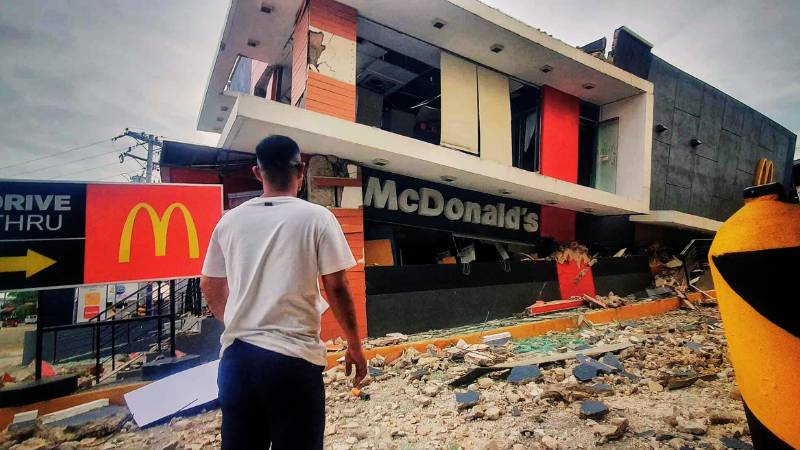
The aftermath of the September 30, 2025 earthquake in Bogo City, Cebu, Philippines. ALDO BANAYNAL/THE FREEMAN
Aftershocks from the powerful 6.9-magnitude earthquake that struck northern Cebu on September 30 may continue until December, according to the Philippine Institute of Volcanology and Seismology (Phivolcs). Phivolcs said more than 8,000 aftershocks have already been recorded following the tremor that originated from the Bogo Bay Fault Line. It was the first major seismic event in Cebu in more than 400 years and its strongest recorded earthquake in centuries. “The aftershocks will gradually weaken over the coming weeks,” said Phivolcs Director Teresito Bacolcol. “Reconstruction efforts can proceed, but the public should remain cautious.” The National Disaster Risk Reduction and Management Council (NDRRMC) reported that at least 72 people were killed, more than 500 were injured, and 20,000 were displaced by the quake. A total of 733 infrastructures were damaged across northern Cebu. The quake struck at 9:59pm with its epicenter northeast of Bogo City. It sent thousands fleeing their homes and high-rises, with evacuations reported in Cebu City’s IT Park and nearby business districts. Cultural landmarks also took a hit: the façade of a centuries-old church in Bantayan Island collapsed, while the old Mactan Bridge was temporarily closed for inspection. Even the Miss Asia Pacific International beauty pageant in Cebu was disrupted, as contestants were seen in viral videos running off the stage during the tremor. “This event is a strong reminder that Cebu sits on an active fault system,” Bacolcol said. “Preparedness and strict enforcement of building codes are crucial.” ICA/Expat MediaFor all the latest news from the UAE and the world, follow us on Facebook, Twitter and Instagram and subscribe to our YouTube page










Comments
Leave a Comment