
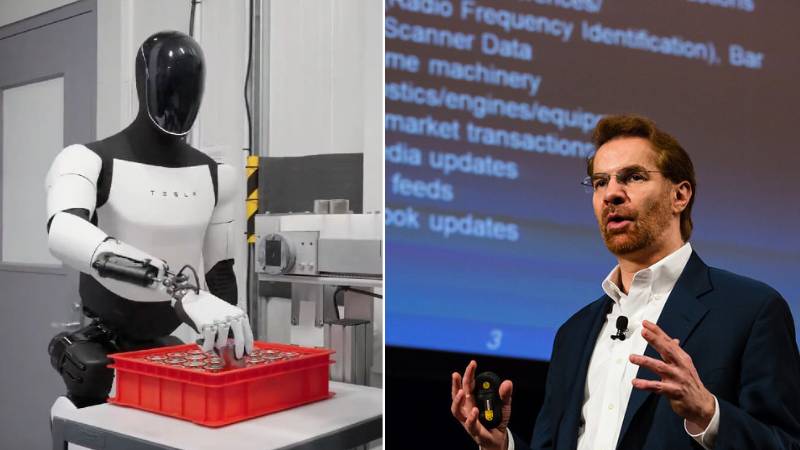
A composite photo of the Optimus robot and Dr. Erik Brynjolfsson. TESLA/ARCHIVE
Artificial Intelligence (AI) will revolutionize work processes by augmenting human tasks rather than replacing jobs entirely, according to Dr. Erik Brynjolfsson, Director of Stanford’s Digital Economy Lab. Speaking at the recent 2024 Global Future Councils (GFC) in Dubai, Dr. Brynjolfsson addressed growing concerns about AI’s potential to disrupt the workforce. Dr. Brynjolfsson argued that AI is a “general-purpose technology” with the power to enhance productivity, not eliminate jobs. “A job is made up of different tasks, and AI can help with some of them,” he explained, citing examples in the medical field where AI assists radiologists by interpreting images, while human expertise is still needed for tasks like administering sedation. According to data presented at the forum, at least 10 percent of workplace tasks will be impacted by AI. However, the professor stressed that the key to managing this transformation lies in prioritizing augmentation over automation. “We should use AI to amplify what people can do,” said Dr. Brynjolfsson, urging policymakers to prepare for a “massive business transformation” over the next decade. He emphasized that businesses and governments need to focus on how AI can augment human capabilities rather than replace them. Recently, Tesla founder Elon Musk unveiled the company’s latest technological innovation, the AI-powered Optimus humanoid robot. Musk described Optimus as a revolutionary product capable of handling everyday human tasks, making it Tesla’s most significant invention yet. Musk emphasized Optimus’ potential to transform daily life. He said that the robot could perform tasks such as carrying packages, walking pets, babysitting, and even bartending. “The Optimus will walk amongst you,” Musk remarked, adding that the robot could eventually be affordable for everyone, with a long-term price projected to fall between $20,000 (Dh73,400) and $30,000 (Dh110,100). Optimus' capabilities were showcased in a live demo, where the robots performed basic actions such as waving, holding cups, and handing out small gifts. A video demonstration highlighted its more practical uses, such as retrieving a package from a porch. However, the robots are still in the early stages of development, with Musk noting that 80 percent of the project is complete, and anticipating that Optimus will be commercially available by late 2024. ICA/Expat MediaFor all the latest news from the UAE and the world, follow us on Facebook, Twitter and Instagram and subscribe to our YouTube page







Comments
Leave a Comment