
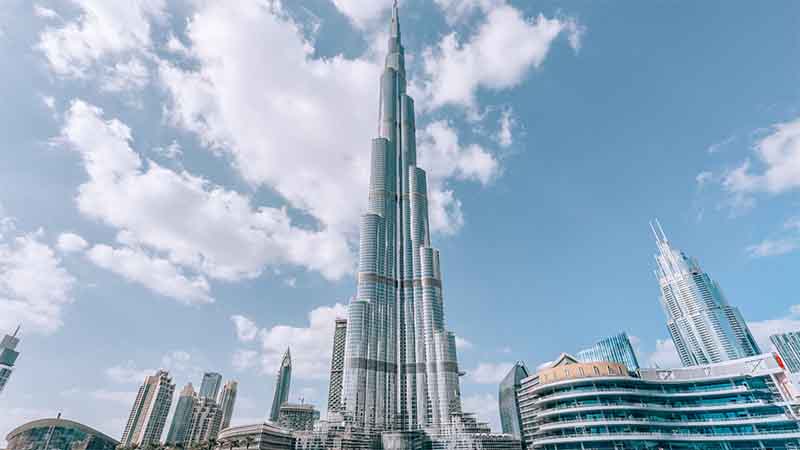
The Burj Khalifa in Dubai.
On January 4, 2010, the iconic Burj Khalifa, the tallest building in the world, officially opened in a spectacular ceremony. However, many might not know that it was initially called Burj Dubai. The renaming to Burj Khalifa was done in honor of the late UAE President and ruler of Abu Dhabi, Sheikh Khalifa bin Zayed Al Nahyan. The new name for the super tower was announced by Sheikh Mohammed bin Rashid Al Maktoum, Vice-President and Prime Minister of the UAE and Ruler of Dubai. Speaking at the opening ceremony, Sheikh Mohammed highlighted the significance of the 828-metre-tall tower, saying, "The highest point in the world should be linked to the big names, and I announce today the opening of Burj Khalifa Bin Zayed." He emphasized that this monumental achievement is a testament to the determination of the UAE’s leadership and people. “I remember being on breaking news watch during the launch ceremony,” long-time Dubai-based journalist Florence Pia Yu told Expat Media. “It really came as a big surprise to everyone when Sheikh Mohammed unveiled the new name at the opening ceremony because every other signage up until that point still bore the name ‘Burj Dubai’,” she recalled. Yu said the renaming of Burj Dubai to Burj Khalifa symbolized the strong ties between Dubai and Abu Dhabi, and the UAE's unified efforts toward growth and progress.A spectacular launch
The opening ceremony of the Burj Khalifa was nothing short of spectacular. Fireworks lit up the night sky, synchronized with a performance by the Dubai Fountains below the tower. The tower was illuminated from top to bottom, and thousands of residents and tourists gathered at the Dubai Mall promenade to witness the unveiling of the world's tallest building. Skydivers, carrying the UAE flag and pictures of Sheikh Mohammed and Sheikh Khalifa, added to the celebration, landing in front of the crowd.Other Dubai landmarks that have changed names
While Burj Khalifa's name change was official and tied to the country’s leadership, other Dubai landmarks have also undergone renaming, albeit for different reasons. Unlike Burj Khalifa, where the name reflects a tribute to a national leader, many of Dubai’s other landmarks are renamed through corporate sponsorships, a process that’s part of a larger trend in Dubai’s infrastructure development. For example, the Coca-Cola Arena, originally called Dubai Arena, was renamed as part of a sponsorship deal with the beverage giant. Located in City Walk, the 17,000-capacity multipurpose indoor arena is now a major entertainment venue in the region, attracting international performers and events. This name change reflects Dubai’s approach to forging public-private partnerships through naming rights.Dubai Metro’s naming rights scheme
Another prime example of Dubai’s unique naming rights model is the Dubai Metro. Since 2009, the Roads and Transport Authority (RTA) has offered companies the opportunity to purchase naming rights for metro stations as part of a 10-year agreement. This allows businesses to gain significant brand exposure while contributing to the development of Dubai’s transportation infrastructure. Stations like Insurance Market Metro Station (formerly Mashreq), Sobha Realty Metro Station (formerly Dubai Marina) and Onpassive Metro Station (formerly Al Safa) are just a few examples of how companies can leverage these naming rights. By acquiring the name of a metro station, businesses can tap into the city’s bustling transportation network, which serves millions of commuters every year. These partnerships help fund improvements to the city’s infrastructure while offering companies unique advertising platforms. Under this scheme, the station retains its new name for a decade before the naming rights can be renewed or transferred to another company. This balance of public and private collaboration is key to Dubai’s forward-thinking development strategy.Importance of name changes in Dubai’s landscape
From Burj Dubai to Burj Khalifa and Dubai Arena to Coca-Cola Arena, these name changes represent more than just rebranding—they reflect the growth, ambition, and innovative spirit of Dubai. Whether through honoring national leaders or forging corporate partnerships, Dubai's landmarks continue to evolve, aligning with the city’s vision of progress and global competitiveness. While some name changes are permanent, like Burj Khalifa, others may shift every decade, particularly under Dubai’s naming rights schemes. This dynamic approach allows the city to remain at the forefront of global innovation, providing opportunities for businesses while enhancing its infrastructure. ICA/Expat MediaFor all the latest news from the UAE and the world, follow us on Facebook, Twitter and Instagram and subscribe to our YouTube page





Comments
Leave a Comment