
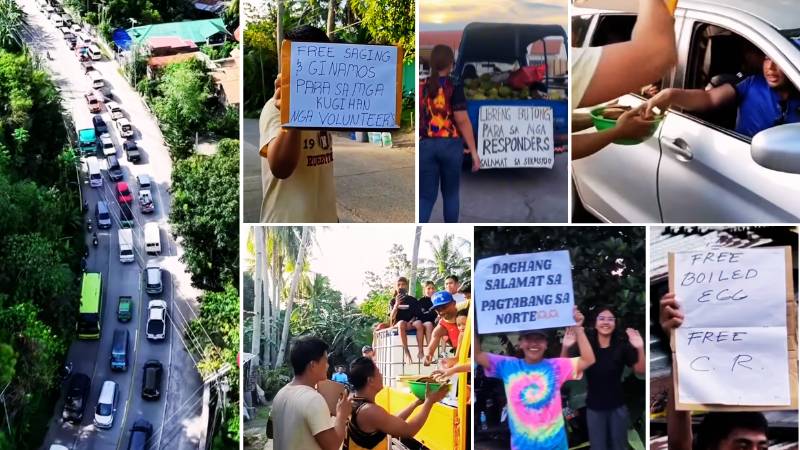
A montage of the community spirit in Cebu, Philippines following a strong earthquake that rocked the province on September 30, 2025.
In northern Cebu, where the ground still trembles from aftershocks, the spirit of bayanihan has taken center stage. A week after a powerful 6.9-magnitude earthquake struck Bogo City and nearby towns, thousands of residents remain displaced. Yet even among the ruins, survivors are finding ways to give back to the strangers who came to help. Along the roads leading to the hardest-hit areas, quake victims have been seen lining up to offer free bananas, coconuts, coffee, and even macaroni soup to donors, volunteers, and responders who braved more than ten hours of traffic to reach them. Others opened their homes as rest stops for volunteers, offering water and the use of their toilets. One elderly man, holding a small basket of boiled bananas, waved down a group of civilian volunteers to hand them food. “My heart swelled seeing that even though they are victims too, they still thought of giving. It makes me proud to be Filipino,” a local donor said in Cebuano. Social media has been flooded with videos showing similar acts of generosity from victims themselves — a quiet testament to the strength of the Filipino heart. Meanwhile, traffic on the highways to Bogo City remains heavy, but for once, it’s “the good kind.” Private vehicles as well as government trucks from other parts of Cebu, including Cebu City and Talisay City, as well as other cities in the country, such as Davao City, Zamboanga City and South Cotabato are filled with groceries, bottled water, rice, and food packs bound for far-flung communities. Many private donors made the more than 12-hour journey north on little sleep, choosing to hand-deliver aid directly to families they saw online pleading for help. “Any help will do, even just for the children,” said resident Daniela Pepito from Sitio Takdan 2 in Bogo. “Many households are here, but we feel forgotten compared to those along the main roads.” That feeling of being “forgotten” sparked waves of volunteer missions — students, civic groups, and private citizens forming caravans to reach the remotest barangays. Even a simple ₱19 donation from an elderly man who arrived at a volunteer center captured the nation’s heart. “He asked if we’d still be here on Monday because he wanted to collect old T-shirts to donate,” volunteer Jennivieve Abelgas Caminero shared in her viral post. According to the Philippine Institute of Volcanology and Seismology (Phivolcs), the 6.9-magnitude quake that struck on September 30 was the strongest ever recorded in Cebu. It originated from the Bogo Bay Fault Line and was followed by over 8,000 aftershocks, killing at least 72 people and injuring more than 500. More than 20,000 residents were displaced. Governor Pamela Baricuatro praised the wave of compassion but urged coordination. “We appreciate the overwhelming support, but we ask private individuals and organizations to centralize the donations. It is not advisable for everyone to go there and do their own distribution,” she said. Still, for many volunteers, the drive was personal. The sight of quake victims giving back — despite losing everything — has left an indelible mark. CAM/PIA/Expat MediaFor all the latest news from the UAE and the world, follow us on Facebook, Twitter and Instagram and subscribe to our YouTube page







Comments
Leave a Comment