
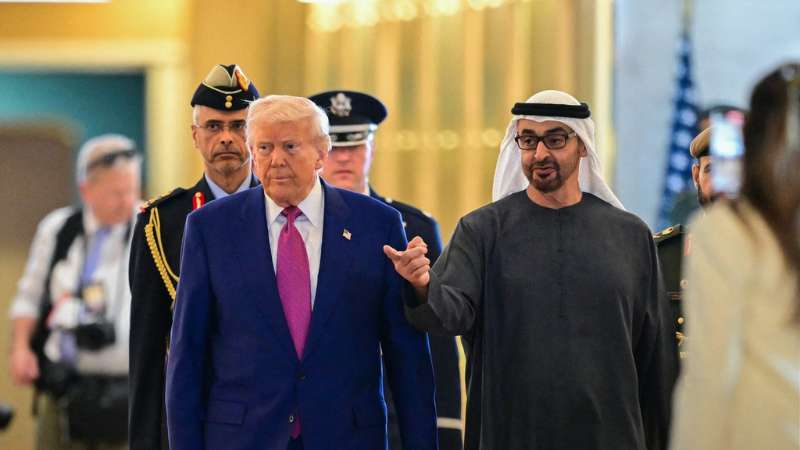
UAE President Sheikh Mohamed bin Zayed Al Nahyan welcomes US President Donald Trump in Abu Dhabi on May 15, 2025. SUPPLIED
US President Donald Trump arrived in Abu Dhabi on Thursday (May 15) on the final stop of his three-day state visit to the Gulf, which included earlier visits to Saudi Arabia and Qatar. Trump's arrival in the UAE was marked by a ceremonial welcome, with his aircraft escorted into UAE airspace by fighter jets, mirroring a similar gesture extended during his stop in Qatar. Upon landing at the presidential terminal, Trump was warmly received by UAE President Sheikh Mohamed bin Zayed Al Nahyan. This visit—Trump’s first state visit to the Gulf since returning to office in January—is aimed at strengthening bilateral cooperation across a range of sectors, particularly technology and investment. According to the White House, key topics on the agenda in Abu Dhabi include deepening US-UAE partnerships in artificial intelligence and the energy sector; removing Biden-era restrictions on microchip and tech exports and supporting the UAE’s AI 2031 strategy, which aims to position the country as a global AI leader. Notably, the UAE has previously committed to investing $1.4 trillion in US industries over the next 10 years. White House Press Secretary Karoline Leavitt described the trip as a “historic return to the Middle East,” underscoring the administration’s efforts to reestablish strategic Gulf partnerships. “The President views this region as a cornerstone of global cooperation, especially in energy, security, and innovation,” she said. Another major goal of the visit is reviving and expanding the Abraham Accords, which Trump helped broker during his first term, normalizing diplomatic ties between Israel and several Arab nations. According to US Middle East envoy Steve Witkoff, Trump’s administration is “actively working to bring Saudi Arabia into the Abraham Accords framework,” despite Riyadh previously pausing normalization talks after Israel’s war in Gaza in 2023. Beyond the UAE, Trump’s broader Gulf agenda included securing Saudi investments, finalizing arms deals, discussing military cooperation with Qatar, and advocating for a ceasefire and peace plan in Gaza. He is also expected to decouple Saudi nuclear cooperation from normalization with Israel—a shift from Biden-era policy. ICA/Expat MediaIn pictures
For all the latest news from the UAE and the world, follow us on Facebook, Twitter and Instagram and subscribe to our YouTube page









Comments
Leave a Comment