
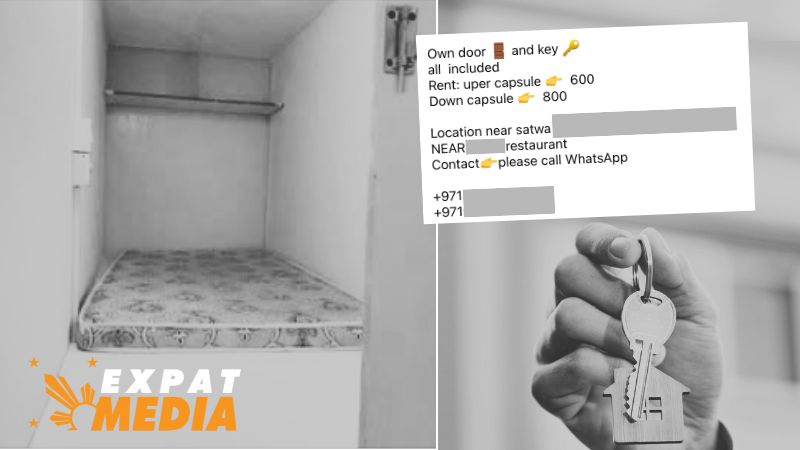
A capsule apartment in Dubai. EXPAT MEDIA
Closet-sized “capsule apartments” in Dubai’s Satwa and Al Barsha areas have drawn mixed reactions from residents for offering ultra-cheap accommodation at just Dh600 per month. But the trend is now raising concerns about livability, legality, and safety. The pod-like accommodation, barely wide enough to fit a single mattress, is accessed by crouching into the confined space—reminiscent of capsule hotels in Japan. One listing found by Expat Media says the monthly rent includes free electricity, water and Wi-Fi. While some residents see the capsule as a cost-effective option, others argue that it compromises minimum living standards. “This might be okay for a few days but as an accommodation, I don’t think it is very livable in the long term,” Marvin, a Dubai resident, told Expat Media. Another resident, Ethan B., echoed the sentiment, saying, “It’s definitely a practical option for low-income workers while also giving them a bit of privacy compared to living in bunk beds in partitioned rooms. But honestly, it’s like being in a coffin, and for sure there would be safety concerns there.” Ethan, who recently moved from a Dh2,000-per-month room rental to a more affordable shared space in Deira, said his previous landlord attempted to hike his rent to Dh2,400, which he found “excessive.” “The landlord wanted to increase my rent, saying that apartment rentals increased this year. I thought a 20 percent increase was too much, considering that the building isn't new,” he said, adding that he would not consider moving into a capsule apartment even if it meant paying the lowest rent. The controversial capsule pods are part of a growing trend that mirrors partitioned accommodations, which are widespread but technically illegal. A Dubai Land Department representative confirmed to Expat Media that “room partitions remain not legal” and that inspections are ongoing. Landlords and tenants caught violating housing regulations—such as illegally partitioning rooms or creating makeshift units—have been fined and ordered to dismantle unauthorized constructions. Authorities stress that residential overcrowding and unlicensed partitions are violations of UAE’s housing law, which considers a unit overcrowded if it exceeds appropriate occupancy based on size and facilities. Penalties can reach up to Dh1 million. According to the municipality, such practices harm the community by overburdening infrastructure, risking public health, and distorting the city’s image. Field inspections are being intensified to combat what the government describes as “random constructions” and uncivilized housing practices.Rising rents fuel micro-living trend
The emergence of capsule apartments reflects the mounting pressure on low- to mid-income earners in Dubai, as rents soar past pre-pandemic levels. Data from Property Finder Community Insights provided to Expat Media reveals that even the cheapest average annual rent for a one-bedroom apartment is now Dh65,000 in Dubai Silicon Oasis and Dubai Production City; Dh69,999 in Deira; Dh77,000 in Bur Dubai; Dh79,000 in Karama; Dh79,999 in Al Furjan and Dh80,000 in JVC. In contrast, partitioned rooms now cost an average of Dh1,100 to Dh1,800 per month, making the Dh600 capsule a striking, albeit extreme, alternative. Capsule-style accommodations were first introduced in Osaka, Japan in the late 1970s to provide affordable, temporary rest for urban workers. Since then, capsule hotels have become popular in cities such as Tokyo, Kuala Lumpur, Singapore and Bali, targeting budget travelers and digital nomads. But while these pods are seen as stylish and modern alternatives in the hospitality world, their adaptation as long-term homes in Dubai is facing a critical backlash. “This is not a hotel for tourists. People are expected to live here long-term. That changes the conversation entirely,” Dubai resident Carolina told Expat Media. As Dubai authorities continue to crack down on unauthorized residential modifications, the capsule apartment trend could be short-lived—unless developers and landlords find legal, safe, and humane ways to adapt the concept. ICA/PIA/CAM/Expat MediaFor all the latest news from the UAE and the world, follow us on Facebook, Twitter and Instagram and subscribe to our YouTube page












Comments
Leave a Comment