
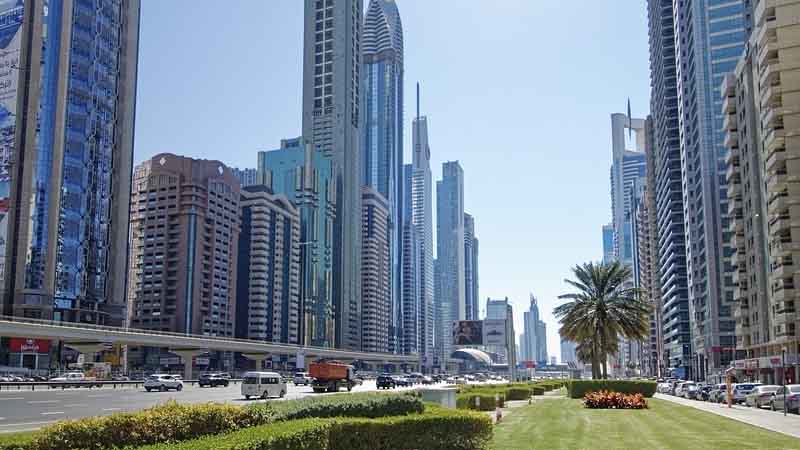
The skyscrapers along Sheikh Zayed Road in Dubai. ARCHIVE
Private sector companies in Dubai are being encouraged to adopt remote work arrangements for employees as authorities introduce a Traffic Flow Plan aimed at alleviating the city’s traffic congestion. The Traffic Flow Plan, which has been approved by Sheikh Hamdan Bin Mohammed Bin Rashid Al Maktoum, Crown Prince of Dubai, aims to decrease traffic congestion by as much as 30 percent. The initiative focuses on flexible working hours and remote work arrangements, encouraging both public and private sector organizations to adopt these policies. The Roads and Transport Authority (RTA) and the Dubai Government Human Resources Department (DGHR) conducted a comprehensive analysis to gauge the feasibility of this initiative. Their research included two extensive surveys covering 320,000 employees across 644 private companies. According to the survey data, 32 percent of companies currently offer remote work options, while another 58 percent are open to introducing such policies. Additionally, 31 percent of companies have implemented flexible working hours, and 66 percent have indicated interest in adopting them. A critical finding from the study shows that implementing a two-hour flexible start time combined with remote work options could reduce peak-hour traffic by nearly 30 percent. Projections reveal that if 20 percent of employees transitioned to remote work, traffic congestion on major thoroughfares like Sheikh Zayed Road and Al Khail Road would reduce by 9.8 percent and 8.4 percent, respectively. Flexible work hours alone could cut volumes by 5.7 percent on Sheikh Zayed Road and 5 percent on Al Khail Road, alleviating stress on the city’s infrastructure. Mattar Al Tayer, RTA Commissioner General, emphasized that the Traffic Flow Plan is a holistic strategy aimed at enhancing the city’s transport infrastructure. “This strategy goes beyond remote work,” he explained. “It includes expanding public transport routes, increasing dedicated lanes for buses, and implementing truck movement restrictions.” The initiative aligns with Dubai’s long-term vision of becoming one of the world’s most livable cities, with a focus on quality of life and community well-being. Abdulla Ali Bin Zayed Al Falasi, Director General of DGHR, noted that remote work has already seen great success within Dubai Government departments. “Since 2020, 80 percent of government entities have offered remote work, with 87 percent of employees finding flexible hours beneficial for their work-life balance,” Al Falasi reported. He emphasized that this policy not only boosts employee productivity but also plays a crucial role in traffic management by distributing traffic more evenly throughout the day. The government plans to monitor the effectiveness of these policies and may consider expanding them based on initial outcomes. Authorities hope that the private sector will embrace these changes to create a ripple effect across the city’s workforce, ultimately leading to significant improvements in traffic flow and quality of life for Dubai residents. ICA/Expat MediaFor all the latest news from the UAE and the world, follow us on Facebook, Twitter and Instagram and subscribe to our YouTube page












Comments
Leave a Comment