
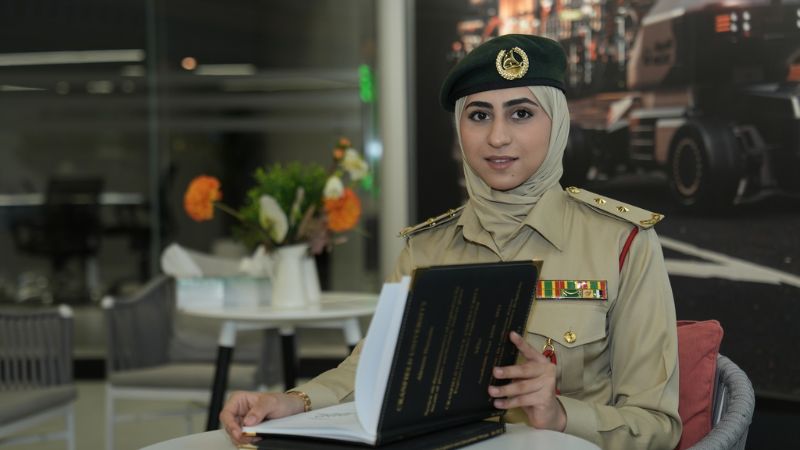
First Lieutenant Engineer Al Reem Abdul Rahman Abdullah Ali's research at Cranfield University targets explosives-related pollution.
Dubai Police's First Lieutenant Engineer, Al Reem Abdul Rahman Abdullah Ali has made a contribution to the global fight against environmental pollution through her study conducted at the UK's Cranfield University, focusing on reducing pollution caused by explosives and hazardous waste, including military arms production and field operations. The study introduces a practical approach to decontaminating areas affected by explosives, using Vetiver grass (Chrysopogon zizanioides), a 'vegetative' bioremediation method known for its efficiency and cost-effectiveness. This exhibits adaptability, resilience, and the ability to absorb explosive materials, making it suitable for effective cleanup. The grass's deep roots enable it to reach depths of up to 4 meters underground, making it a practical solution. First Lieutenant Al Reem Abdul Rahman emphasized the importance of scientific research in addressing environmental concerns, saying, "Explosives-related pollution and hazardous waste have become critical global issues. This pollution persists due to the hazardous nature of explosive substances, affecting not only humans but also animals, microorganisms, and marine life." Highlighting the global cooperation for climate action, she noted the upcoming 28th Conference of the Parties on Climate Change (COP 28), hosted by the UAE, as a platform for united efforts. Dubai Police was praised for fostering an environment that encourages innovative solutions, with initiatives like the Scholars Council supporting creative ideas. KKL/Expat MediaFor all the latest news from the UAE and the world, follow us on Facebook, Twitter and Instagram and subscribe to our YouTube page











Comments
Leave a Comment