
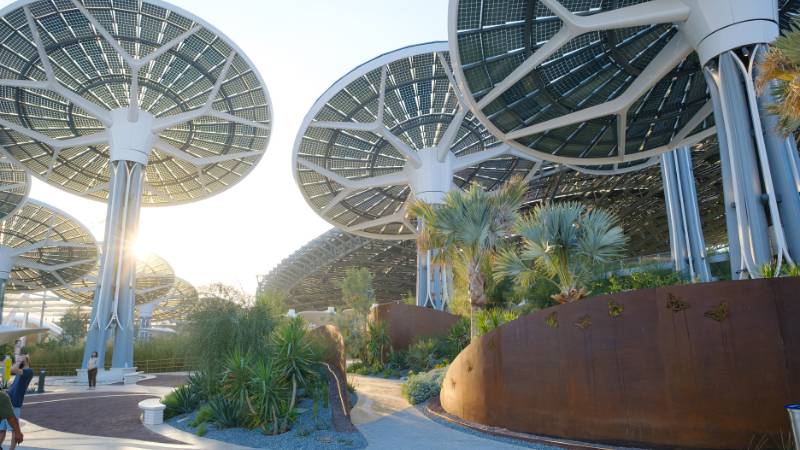
The Terra – The Sustainability Pavilion in Expo City Dubai. ARCHIVE
The Royal Institute of British Architects (RIBA) has unveiled the 15 finalists for its inaugural Middle East Award, with Dubai and the wider UAE dominating the shortlist of groundbreaking architectural projects. From Expo 2020 landmarks to sustainability-driven cultural destinations, UAE entries stood out among projects from Saudi Arabia, Qatar, and Bahrain. The winner will be announced during Dubai Design Week on November 5, followed by a dedicated event on November 7. Dubai’s shortlisted projects highlight the city’s reputation for innovation: • Expo 2020 Thematic Districts by Hopkins Architects – A set of walkable urban districts designed to minimize car use, featuring shaded streets and sustainable building methods that adapt to the desert climate. • Terra – The Sustainability Pavilion by Grimshaw and partners – A benchmark in green architecture, the pavilion generates its own energy and water through solar panels and underground water recycling, setting new standards in climate-responsive design. • Jafar Centre, Dubai College by Godwin Austen Johnson – A flexible STEM learning hub prioritizing natural light, acoustics, and energy efficiency, offering students an inspiring environment for science, technology, engineering, and mathematics. • The Fold by Huna – A bold cultural landmark and community destination that blends art, performance, and architecture into a dynamic public space. • The H Residence by tkdp – A contemporary residential project reflecting modern urban living with an emphasis on fluid, sustainable design for Dubai’s dense cityscape. • World Food Waste Teahouse: Arabi-an by Mitsubishi Jisho Design – The world’s first “food-concrete” structure, constructed from waste materials like tea leaves and dried fruits to create biodegradable and demountable tea spaces. • Al Wasl Plaza by Adrian Smith + Gordon Gill Architecture – The symbolic heart of Expo 2020, crowned with a 130-meter-wide steel trellis dome that doubles as the world’s largest 360-degree projection surface. • Singapore Pavilion, Expo 2020 by WOHA – A climate-responsive pavilion with lush greenery, skywalks, and passive-cooling strategies that showcase sustainable tropical urbanism. Beyond Dubai, other UAE entries include The Serai Wing, Bait Khalid Bin Ibrahim by ANARCHITECT in Sharjah, which transformed two 1950s family homes into a boutique heritage hotel, and the Khor Kalba Turtle and Wildlife Sanctuary in Kalba by Hopkins Architects, a cluster of rounded pavilions supporting the rehabilitation of turtles and endangered birds. The shortlist also features ambitious projects from across the GCC. In Saudi Arabia, King Salman Park by Gerber Architekten, Buro Happold, and Setec is one of the world’s most ambitious urban transformations—turning a former airport site into a 16.7 km² green oasis, pioneering desert soil revitalisation, sustainable water use, and climate-resilient planting. Also in Riyadh, the Wadi Safar Experience Center by Dar Al Omran – Rasem Badran blends modern immersive experiences with traditional Najdi architecture, serving as a cultural gateway to Saudi Arabia’s Vision 2030 megaprojects. In Qatar, the spotlight falls on the Al-Mujadilah Center and Mosque for Women by Diller Scofidio + Renfro in Doha—the first purpose-built contemporary women’s mosque in the Muslim world. Its undulating roof, punctuated by over 5,000 light wells, creates a luminous, contemplative atmosphere while setting a precedent for inclusive religious architecture. Bahrain is represented by the Al Dana Amphitheatre by S/L Architects in Sakhir, a state-of-the-art open-air performance venue carved into the desert rock. Designed with sustainability and natural acoustics in mind, the amphitheatre has quickly become one of the kingdom’s premier cultural landmarks, hosting concerts and large-scale events in a dramatic natural setting. Kerem Cengiz, Jury Chair for the Middle East Awards, described the shortlist as “a powerful reflection of a region in architectural renaissance, where cultural identity is alive, evolving, and deeply embedded in contemporary form.” Chris Williamson, RIBA President, praised the UAE projects for balancing innovation and heritage, noting that they “stand out for their creativity, sustainability, and human focus.” The RIBA Middle East Award recognizes architecture that redefines city living, addresses climate challenges, and creates inclusive spaces. For Dubai, the dominance of its entries underscores its growing role as a hub of global architectural innovation—while Saudi Arabia, Qatar, and Bahrain’s ambitious projects show that the entire region is shaping a new architectural identity on the world stage. ICA/Expat MediaFor all the latest news from the UAE and the world, follow us on Facebook, Twitter and Instagram and subscribe to our YouTube page








Comments
Leave a Comment