
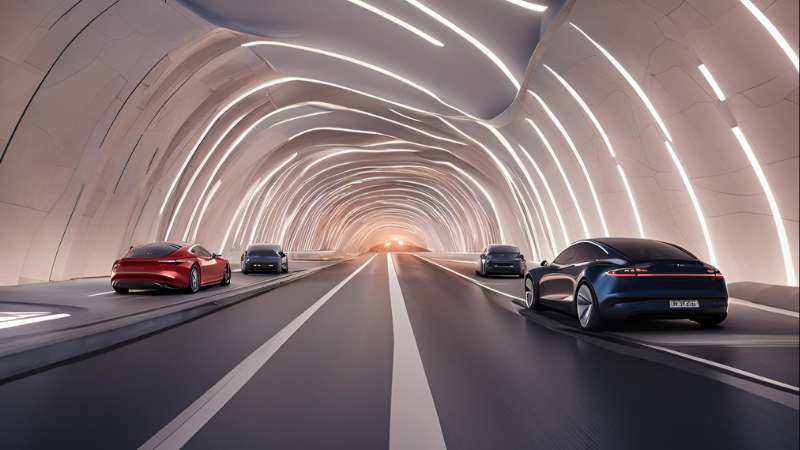
An AI-generated impression of the Dubai Loop.
Tech billionaire Elon Musk’s Boring Company is set to revolutionize urban mobility in Dubai with the Dubai Loop, an underground high-speed tunnel system aimed at providing seamless, efficient, and rapid transportation across the emirate. Announced during the recent World Governments Summit in Dubai, the project will connect key areas of the city via a network of tunnels designed to facilitate faster, safer, and more efficient commutes. “It will be like a wormhole,” Musk said. “You just wormhole from one part of the city and boom, you’re out in another part of the city. I think once people try it, they will think this is really cool.” The Dubai Loop is a collaboration between Musk’s Boring Company and Dubai’s Roads and Transport Authority (RTA). A formal agreement was signed last week, strengthening the partnership for tunnel excavation and construction. The proposed system will cover a 17-kilometer route with 11 stations, capable of transporting more than 20,000 passengers per hour. Electric vehicles traveling at speeds of up to 160 km/h will be used, significantly reducing travel times across the city. The RTA highlighted the advantages of the project, stating, “The technology used in the system offers rapid execution at a lower cost than conventional tunneling methods, with minimal impact on existing infrastructure and road networks.” Transportation experts suggest that the Dubai Loop should be seamlessly integrated with the city's existing transit systems, including the Dubai Metro, Etihad Rail, and bus networks. “The loop should complement Dubai Metro lines by filling coverage gaps and ensuring a seamless connection between major residential and commercial hubs such as Downtown Dubai, Business Bay, and Deira,” one expert said. Musk emphasized that the underground system would overcome common transportation barriers such as road congestion and extreme weather conditions, making it a reliable year-round option. Cost projections for the project suggest that the loop will be more affordable to construct than traditional subway systems. A 2.73-km segment, featuring three stations, is estimated to cost Dh172.5 million. This efficient pricing structure could help keep ticket prices reasonable for passengers. While a full timeline for completion has not been announced, initial phases are expected to begin soon as feasibility studies and route planning progress. ICA/Expat MediaFor all the latest news from the UAE and the world, follow us on Facebook, Twitter and Instagram and subscribe to our YouTube page









Comments
Leave a Comment