
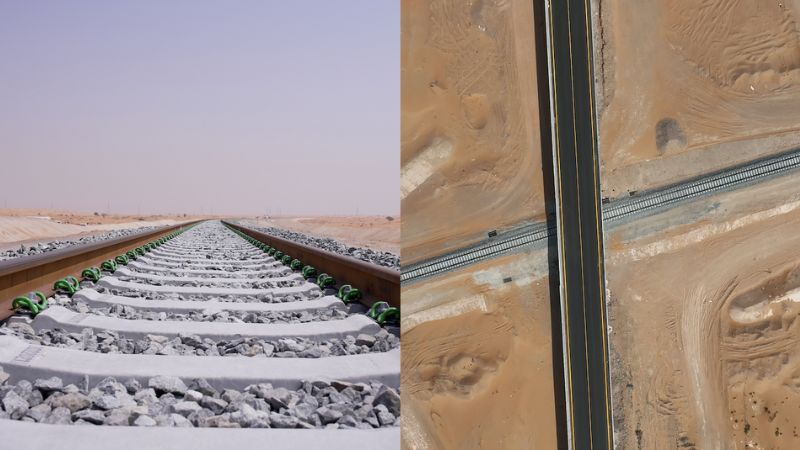
staff reporter. SUPPLIED
The UAE's national rail project advanced significantly after Ras Al Khaimah and Sharjah were linked to the network. Etihad Rail announced Wednesday that tracklaying work to connect the two emirates to Ghuwaifat in the country's west had been completed.The transportation system will eventually span 1,200 kilometers across the UAE, from the Saudi border to Fujairah. The railway will connect the UAE's major trade, industry, manufacturing, production, logistics, and population centers, as well as all major import and export points. It will be an integral part of the GCC railway network. On Monday, Sheikh Mohammed bin Rashid, Vice President and Ruler of Dubai, said the Etihad Rail project would "change the infrastructure map in the country." Etihad Rail announced in May that 75% of the network had been completed. The building process is divided into two stages, the second of which includes four packages. Stage one, a freight service connecting the gas fields of Shah and Habshan to Ruwais, began operations in 2016. It transports up to 22,000 tonnes of granulated sulfur daily from Habshan and Shah to Ruwais for the Abu Dhabi National Oil Company. Stage two connects Ghuwaifat in the west to Fujairah in the east and includes the most recent rail links to Sharjah and Ras Al Khaimah. Etihad Rail stated that work to connect Fujairah to the network would begin in the coming weeks. The Sharjah line is 45 kilometers long and is part of the project's final package, 145 kilometers long. The Ras Al Khaimah line is 5.7 kilometers long and connects the emirate to the main line of the project. "Today, we have made remarkable strides by completing the main works for the UAE National Rail Network and connecting it to the main lines in Sharjah and Ras Al Khaimah," said Khuloud Al Mazrouei, Etihad Rail's deputy project manager. She stated that Etihad Rail was on track to complete the ambitious project on time and meet its goal of "providing an efficient and sustainable transport network that connects the country's emirates and the UAE with the region." Once operational, passenger trains carrying up to 400 people will reach speeds of up to 200 kilometers per hour. There is no set start date for the passenger service, but officials estimate that more than 36 million people will use it annually by 2030. Passengers can expect a travel time of 50 minutes between Abu Dhabi and Dubai and about 100 minutes between Abu Dhabi and Fujairah, significantly reducing commute times. BKM/ Expat MediaWe have achieved significant progress with the network expansion by successfully connecting the Emirates of Sharjah and Ras Al Khaimah to the UAE National Railway Network’s main line. With the completion of this milestone, pic.twitter.com/XTSfcVSb6E
— Etihad Rail (@Etihad_Rail) October 12, 2022
For all the latest news from the UAE and the world, follow us on Facebook, Twitter and Instagram and subscribe to our YouTube page









Comments
Leave a Comment