
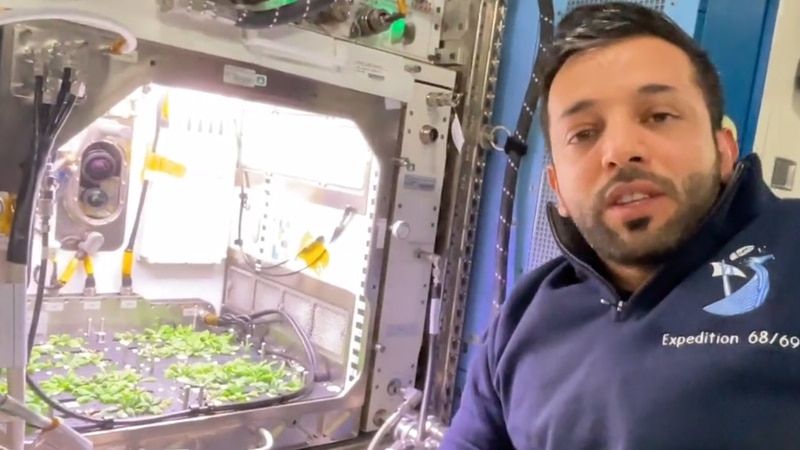
UAE astronaut Sultan AlNeyadi in the Advanced Plant Habitat onboard the International Space Station. SULTAN ALNEYADI/X
UAE astronaut Sultan AlNeyadi conducted more than 200 experiments during his 6-month space mission onboard the International Space Station (ISS). AlNeyadi returned to Earth on Monday (September 4). He accomplished a number of firsts for a UAE astronaut during this mission, including becoming the first Arab to complete a 7-hour spacewalk. AlNeyadi, along with his Expedition 69 crew members, have made significant strides in various research in space. Here are some of the interesting experiments he conducted:Sleep analysis and dream experiment
Al Neyadi completed an experiment on the ISS that seeks to reveal more about sleep quality on extended missions. The Emirati astronaut wore specially-designed headband to capture key data. The Dreams experiment used the "dry-EEG (electroencephalography)" system to monitor sleep patterns of astronauts in the microgravity environment on the space station. The unique conditions aboard the space station, where astronauts witness 16 sunrises and sunsets each day, can disrupt the natural day to night cycle, significantly affecting sleep patterns. “This research helps us learn more about sleep disorders in humans and the health problems they experience on earth,” AlNeyadi said.Plant biology and farming in space
AlNeyadi also tried space farming, and harvested leaves from the plant nursery aboard the ISS. The space station has an Advanced Plant Habitat where plants are grown. “The scientists back on our home planet will analyse these samples to understand how microgravity affects plant growth,” he said. Last April, the UAE astronaut harvested tomatoes on the space station, which were sent back to Earth for research.Cardinal Heart 2.0
AlNeyadi took part in the "Cardinal Heart 2.0" study by Stanford University. The experiment aimed to explore the effects of clinical drugs on heart cells in microgravity using heart tissues. Discoveries from such studies could help prevent cardiovascular risk for space explorers and patients with heart disease on Earth.Cardiobreath experiment
AlNeyadi also contributed to the Cardiobreath experiment on the ISS. The experiment is a critical analysis of the impact of microgravity on cardiovascular and respiratory functions and was conducted in collaboration with the Canadian Space Agency, Simon Fraser University and The University of North Dakota.Microbial experiment
AlNeyadi also participated in the host-pathogen experiment to analyse the reaction between astronauts’ immunity and the microbial pathogens on the ISS. This experiment was conducted in collaboration with NASA’s Johnson Space Centre. The results of the study would be analysed through AlNeyadi’s DNA samples collected aboard the ISS and on Earth. The host-pathogen study examines the interaction between astronauts and microbial pathogens that may be present within the environment of the space station. The experiment will help researchers understand the effects of stress hormones and latent virus reactivation in the astronaut’s immunity system.Protein Crystal Growth Experiment
AlNeyadi engaged in an innovative Protein Crystal Growth Experiment on board the Kibo module on the ISS. The experiment was launched on the Space X-28 cargo mission and was installed by AlNeyadi. One of the major purposes of the protein crystal growth experiments is the contribution to the development of medical treatments. ICA/Expat MediaFor all the latest news from the UAE and the world, follow us on Facebook, Twitter and Instagram and subscribe to our YouTube page








Comments
Leave a Comment