
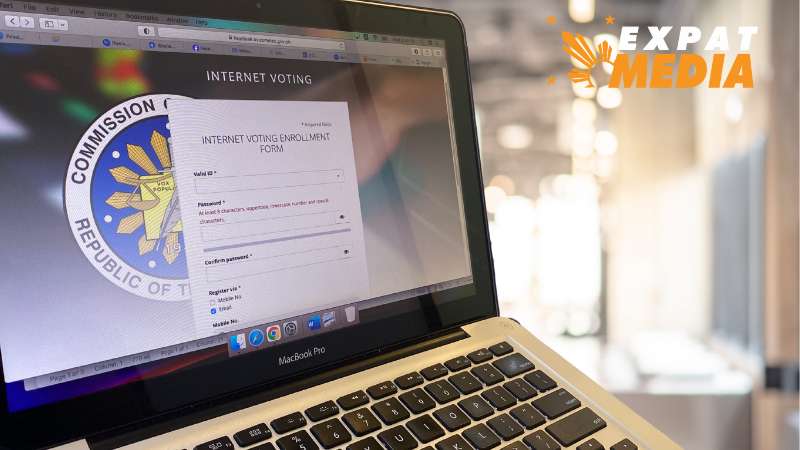
Comelec's pre-enrollment website for online voting. EXPAT MEDIA
Political party PDP-Laban has filed a petition before the Supreme Court to stop the Commission on Elections (Comelec) from implementing internet voting for overseas Filipinos in the upcoming May 2025 midterm elections. In their petition for prohibition and mandamus, with an urgent plea for a temporary restraining order (TRO), the petitioners questioned the legality of remote online voting and the automated vote-counting process. “Our major contention is the automated counting of votes,” the petition read. “It violates Section 31 of the Election Automation Law, which mandates manual counting of ballots at the precinct level.” Petitioners argued that digital ballots are not sanctioned by any existing Philippine law. “Winala ang manual counting of votes, ginawang electronic, and electronic counting was already repealed by RA 9369,” lawyer and petitioner Israelito Torreon explained during a press briefing. He said the Comelec bypassed the legislative process by issuing three resolutions that introduced online voting. “Wala pang batas on online voting,” Torreon emphasized. “There should be clear safeguards and consultation with stakeholders before implementing such a major change.” The petition was filed by PDP-Laban Vice Chairman Alfonso Cusi, along with Torreon, Raul Lambino, Jimmy Bondoc, Vic Rodriguez, Glenn Chong, and other overseas Filipinos. In response, Comelec Chairman George Garcia defended the commission’s actions, saying, “Sinasabi nila walang batas, ang amin pong interpretasyon, yung RA 10950… ay nagsasabi na ang Comelec can venture on other modes of voting.” Garcia added that Comelec consulted the House and Senate Electoral Reforms Committees four times and received no objections. “As of now, the Comelec will proceed internet voting in 77 posts abroad,” he confirmed. “Around 19,000 overseas Filipinos have already enrolled in the new voting system out of 1.241 million registered voters.” Should the Supreme Court issue a TRO, Garcia said Comelec has contingency plans: “May 16,000 na excess na makina kami… kahit pa may contingency, yung mga balota napakadali namin iimprenta.” In the UAE, a total of 189,892 registered overseas voters are expected to cast their ballots. Online voting will run from April 13 to May 12, with polls closing at 3pm (UAE time) on the final day. The switch to online voting has drawn mixed reactions among Filipinos in the UAE. In an Expat Media news post announcing the upcoming online vote, many netizens voiced concern of fraud, saying that the voting process has not been tested before. Others, however, lauded the change, saying it makes the voting process faster and more convenient. "Finally, I don't have to travel far to vote," a social media user commented. Others, however, remained doubtful. "What kind of strategy is this? There hasn't even been trial and error to see if it really works!" one person commented in Filipino. "If there is an anomaly, will they be able to point it out?" Johnny (full name withheld) commented. In a previous interview, Director Ian Michel G. Geonanga of the Office for Overseas Voting (Comelec) assured voters that the online voting system is highly secure with “multi-layered security” and authentication and verification measures. According to Comelec, online voting will be implemented in Philippine diplomatic missions in 77 Philippine foreign service posts worldwide, including the UAE. Only 16 posts are not yet ready to adopt online voting and will conduct voting in person and via postal mode. Only registered overseas voters will be allowed to vote, and pre-enrollment required to participate in online voting. The deadline for pre-enrollment is May 7. Comelec has reiterated, adding that this step ensures that only legitimate voters can access the system, preventing fraud and unauthorized access. ICA/Expat Media ALSO READ: How to pre-register for online votingFor all the latest news from the UAE and the world, follow us on Facebook, Twitter and Instagram and subscribe to our YouTube page












Comments
Leave a Comment