
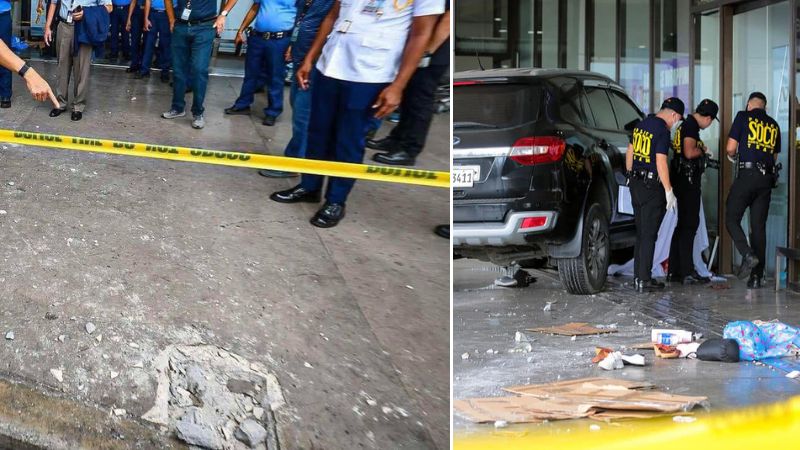
At the scene of the crash at Ninoy Aquino International Airport on May 4, 2025.
Airport authorities and San Miguel Corporation (SMC) have launched a joint investigation into the safety bollards at Ninoy Aquino International Airport (NAIA) Terminal 1, following a deadly SUV crash that killed two people, including a 4-year-old girl and a Filipino man en route to Dubai. The incident occurred on Sunday (May 4), when a Ford Everest plowed through a line of passengers outside the terminal's departure area. The SUV easily broke through the bollards intended to serve as a protective barrier, raising alarm over the reliability of these safety installations. “The purpose of bollards is to stop wayward vehicles… You can see there that the bollards were easily toppled, obviously, because the car moved past it,” said Transportation Secretary Vince Dizon, who personally inspected the crash site. Dizon said SMC, which operates NAIA under a public-private partnership, is now investigating the specifications and materials used in the bollards’ construction. The Manila International Airport Authority also confirmed that the bollards were part of a 2019 safety upgrade under the NAIA rehabilitation plan. The SUV’s driver, who has since undergone inquest proceedings, told investigators that he accidentally stepped on the gas pedal instead of the brakes after being distracted by a passing vehicle. He now faces charges of reckless imprudence resulting in multiple counts of homicide and physical injury, as well as damage to property. On Tuesday (May 6), Philippine President Ferdinand Marcos Jr. ordered an immediate investigation into the installation and procurement of the bollards and assess whether it met safety standards. Outrage followed the revelation that the bollards failed to perform their basic function. “Corruption kills. And today, it took the life of a child… A safety bollard meant to stop that vehicle gave way too easily. Why? Because someone likely cut corners,” wrote lawyer Alman-Najar Namla on social media. Literary critic Katrina Stuart Santiago also weighed in: “These deliberately substandard infrastructures… are a violation of our right to be kept safe, especially in spaces that government is in charge of.”Why did NAIA’s safety bollards fail?
The failure of the bollards has prompted wider scrutiny, particularly as bollards are a global safety standard in high-foot-traffic areas like airports. Properly installed safety bollards are designed to stop or redirect a speeding vehicle, using reinforced concrete, steel cores, and deep foundations. In many major airports around the world, crash-rated bollards are used, which can withstand impacts from vehicles traveling at speeds up to 80 kph. For example: In Los Angeles International Airport, crash-tested bollards installed in 2020 successfully stopped a car that had lost control near Terminal 3, preventing any casualties. In London Heathrow, reinforced bollards are placed as part of a layered defense system following terror threats and traffic incidents. In contrast, NAIA’s bollards appeared to be surface-mounted or poorly anchored, which may have caused them to be dislodged on impact. Security and infrastructure experts point out that non-rated or ornamental bollards, which are common in low-cost installations, provide little real protection and are often installed for aesthetics rather than function. “There are international crash ratings for bollards, such as the ASTM F2656 standard, which defines how much energy a bollard must absorb. If the NAIA bollards didn’t meet any standard rating, then they were decorative at best,” a civil engineer who requested anonymity told Expat Media. A bollard rated F2656 can withstand an impact of a 6,800kg heavy vehicle driving at 48km/hr. As investigations continue, San Miguel Corporation has committed to replacing all ineffective bollards and reviewing all passenger protection measures across NAIA terminals. Meanwhile, Transportation Secretary Dizon has announced reforms that include mandatory drug testing for public utility drivers in partnership with the Philippine Drug Enforcement Agency. The tragedy has reignited public debate over the quality of public infrastructure, especially in transportation hubs where lives are at stake. ICA/CAM/Expat MediaFor all the latest news from the UAE and the world, follow us on Facebook, Twitter and Instagram and subscribe to our YouTube page








Comments
Leave a Comment