
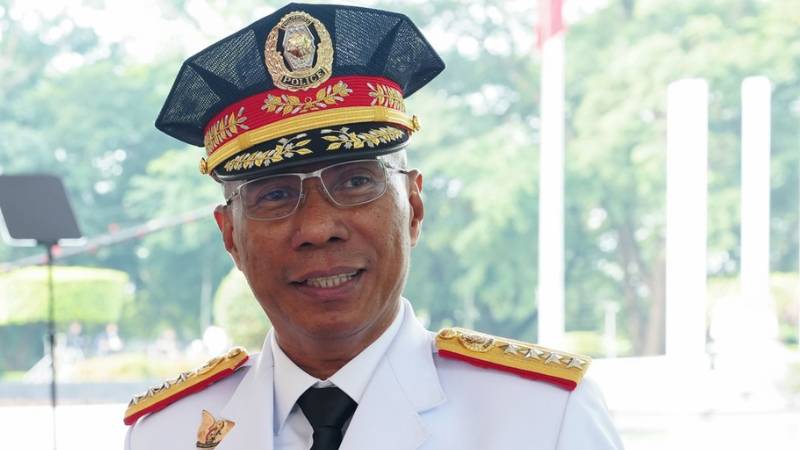
Former Philippine National Police Chief Nicolas Torre. ARCHIVE
Police General Nicolas Torre III has been relieved from his post as chief of the Philippine National Police (PNP) after serving for less than three months, making his stint one of the shortest in the history of the 228,000-strong police force. Malacañang, through Executive Secretary Lucas Bersamin, issued the order on August 25 relieving Torre "effective immediately." A copy of the order was released to media on Tuesday (August 26). Torre, who assumed office last June 2, replacing General Rommel Marbil, was the first PNP chief to graduate from the Philippine National Police Academy (PNPA). Torre’s tenure lasted only 85 days, placing him in the league of the shortest-serving PNP chiefs. His brief term was marked by high-profile operations, including his leadership in enforcing a controversial Interpol warrant against former president Rodrigo Duterte in March, and the arrest of Kingdom of Jesus Christ leader Pastor Apollo Quiboloy in September 2024. But Torre’s tenure unraveled after he unilaterally relieved his second-in-command, Police Lt. Gen. Jose Melencio Nartatez Jr., without clearance from Malacañang or the National Police Commission (Napolcom). Nartatez was named Torre's successor in a ceremony on Tuesday. Former PNP chief and senator Panfilo Lacson criticized Torre's earlier move to demote Nartatez. “Torre acted beyond his authority unilaterally relieving his second-in-command, Nartatez,” Lacson said, stressing that the designation and relief of PNP command group members must be approved by the President or coordinated with Napolcom and the Department of the Interior and Local Government (DILG). Senator Imee Marcos revealed that she had also warned Torre of the consequences. “I called him out and said: ‘Hey, why is it like that? That will come back to you, be careful.’ I didn’t know I would turn out to be right, and I apologize — I had no idea,” she told reporters. Although Torre’s relief was confirmed as a leadership decision and not tied to criminal or administrative charges, his defiance of Napolcom’s order was described as the “breaking point” by Palace insiders. His short-lived stint adds to the list of PNP chiefs with brief terms in the force’s history. According to records, only two other PNP chiefs had unusually brief terms: General Santiago Aliño, who served for 7 months from December 1997 to July 1998. Imperial’s stint was cut short when then president Fidel Ramos opted to appoint another officer to spearhead reforms within the newly restructured police force after the Philippine Constabulary-Integrated National Police merged into the PNP in 1991. Meanwhile, Aliño’s service was brief due to the end of then president Ramos’ term. His appointment coincided with the election transition, and he was succeeded by Panfilo Lacson under the Estrada administration.Napolcom vs Torre
Philippine President Ferdinand "Bongbong" Marcos Jr. has yet to elaborate on the decision, but DILG Secretary and Napolcom chair Juanito Victor “Jonvic” Remulla admitted Torre’s conflict with Napolcom played a key role. Weeks earlier, Philippine media reported on a brewing conflict between the PNP and Napolcom after the commission voided Torre’s reassignment of Police Lt. Gen. Jose Melencio Nartatez Jr. from Deputy Chief for Administration (the PNP’s No. 2 post) to commander of the Area Police Command–Western Mindanao. Napolcom reversed the move and reinstated Nartatez, reminding that the assignments of police colonels up to generals must undergo commission review. “That, among other things, is part of the consideration of the President,” Remulla said, but he refused to disclose further “other” reasons behind Torre’s ouster. The DILG chief also clarified that Torre’s relief was not a sanction. “There is no sanction. The Napolcom has not taken any sanctions as a body, nor has it been discussed, nor has it been filed. This is a personal decision of the President,” Remulla said.What happens next for Torre?
Despite his removal, Torre remains a four-star general until his mandatory retirement in 2027. This creates an unusual scenario: his successor, Lt. Gen. Nartatez Jr., now the 32nd PNP chief, will lead the organization but will not formally carry a four-star rank while Torre remains in service. Nartatez suggested Torre may be placed on floating status under the Office of the Chief PNP, but the leadership imbalance persists unless Torre retires early. Speculation is mounting that Torre may be reassigned to another high-level government post. He has been floated as a potential appointee to either the Department of Public Works and Highways (DPWH), amid controversy over flood control projects, or the National Bureau of Investigation (NBI), left vacant after Director Jaime Santiago’s resignation. “He would be very useful lalo na sa anti-corruption. Magaling siya diyan sa investigation. Lalo na flood control ,” Remulla said, hinting at Torre’s possible redeployment to anti-graft work. Whether Torre accepts a new post or chooses to remain in the PNP will determine if this crisis reaches resolution. For now, Remulla stressed that the president made the decision to “ensure a unified direction” in law enforcement. “The Philippine National Police is a dynamic organization. We are covered by orders and covered by policies. And as a fine Filipino public servant, na minsan ay isang sundalo, susunod lang tayo kung ano ang ibibigay na utos,” Nartatez said at turnover rites in Camp Crame on Tuesday. CAM/MAM/Expat MediaFor all the latest news from the UAE and the world, follow us on Facebook, Twitter and Instagram and subscribe to our YouTube page









Comments
Leave a Comment