
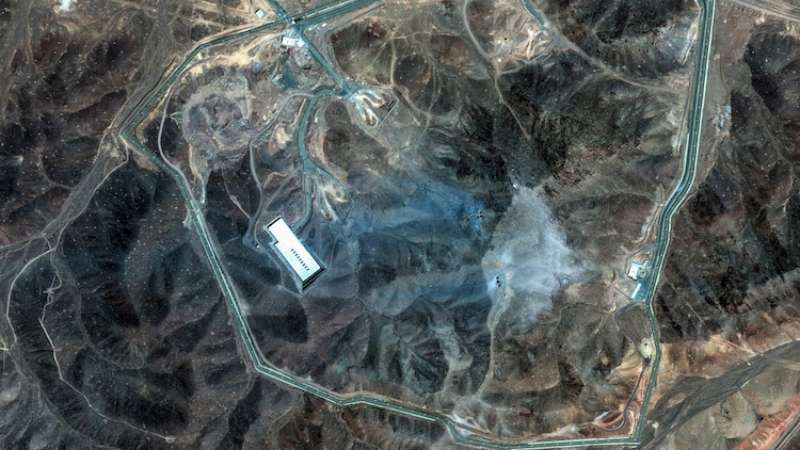
This satellite image shows damage at the Fordo enrichment facility in Iran after US strikes on June 21, 2025. MAXAR TECHNOLOGIES
The Saudi Nuclear and Radiological Regulatory Commission (NRRC) has confirmed that no radiological contamination has been detected in Saudi Arabia, UAE or any Gulf Cooperation Council (GCC) countries following the recent US airstrikes on Iranian nuclear facilities. The GCC comprises Saudi Arabia, UAE, Bahrain, Qatar, Oman and Kuwait. The NRRC posted the assurance via its official account on the X platform, stating that “no radiological effects have been recorded in the environment” of Saudi Arabia or its neighbouring countries. This comes days after US President Donald Trump announced that the US military had carried out "highly successful" strikes on Iran’s three key nuclear facilities—Natanz, Esfahan, and Fordow—on June 21. According to Trump, six bunker-buster bombs were dropped on the Fordow facility, while 30 Tomahawk missiles targeted the other two nuclear sites. US B-2 bombers were reportedly involved in the precision strikes. However, on Wednesday (June 25), a preliminary US intelligence report said that the US strikes failed to destroy Iran's nuclear capability and only set it back by a few months. According to the report by the Defense Intelligence Agency, the strikes damaged the entrances to two of the facilities, but the underground building remained intact, sources close to the findings told media. Iran has maintained that its nuclear research is for civilian energy production. The attacks on Iran's nuclear sites occurred in the context of escalating hostilities between Iran and Israel, which culminated in a 12-day exchange of missile fire. Trump later announced an “unlimited” ceasefire agreement between the two countries, claiming the conflict had the potential to destroy the Middle East but was averted. “In what should be called the ‘12-Day War,’ this is a war that could have gone on for years—but it didn’t, and never will,” Trump wrote on Truth Social, hailing both Iran and Israel for their “Stamina, Courage, and Intelligence.” The ceasefire was reportedly brokered through direct talks between Trump and Israeli Prime Minister Benjamin Netanyahu, while US Vice President JD Vance and Qatari officials held back-channel talks with Iran. Qatar’s involvement proved crucial, with its prime minister playing a key role in Tehran’s agreement to halt hostilities. Despite the ceasefire declaration, Iran launched ballistic missiles in the early hours of Tuesday (June 24), one of which struck a residential building in Be’er Sheva, killing three and injuring eight. Iranian state media confirmed later on Tuesday morning that a ceasefire had been “imposed on the enemy.” ICA/Expat MediaFor all the latest news from the UAE and the world, follow us on Facebook, Twitter and Instagram and subscribe to our YouTube page








Comments
Leave a Comment