
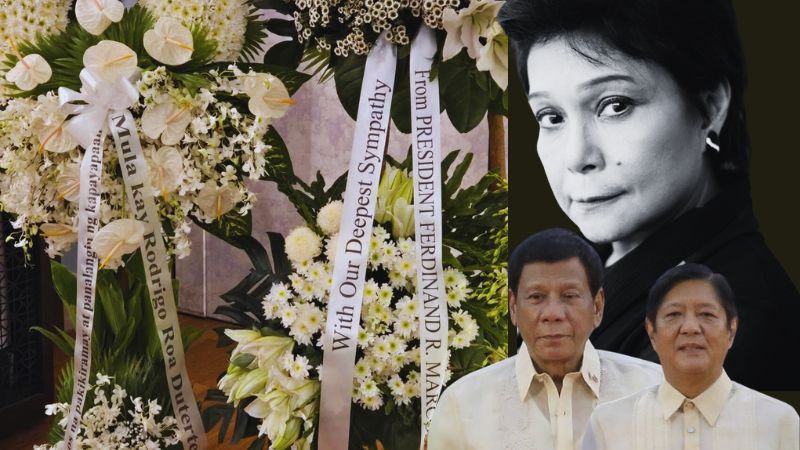
The wreaths from Philippine President Ferdinand Marcos Jr and former Philippine president Rodrigo Duterte. ROMMEL GONZALES/EXPAT MEDIA
Nora Aunor, the iconic “Superstar” of Philippine cinema, almost missed out on the country’s highest artistic honor—but in a dramatic twist befitting her legacy, the recognition finally came, just years before her passing. Aunor, who died last Wednesday (April 16) at the age of 71, was posthumously honored with a Day of National Mourning on April 22 by President Ferdinand “Bongbong” Marcos Jr. The day was marked with the Philippine flag flown at half-mast across all government buildings and installations both locally and abroad. “The passing of National Artist for Film and Broadcast Nora Cabaltera Villamayor, also known as Nora Aunor, is a great loss to the Filipino people and to the nation’s cultural and artistic community,” said Marcos. Yet the path to being named National Artist for Film and Broadcast Arts was not smooth for Aunor. In 2014, the legendary actress was first recommended for the prestigious honor by the joint boards of the Cultural Center of the Philippines and the National Commission for Culture and the Arts (NCCA). However, then president Benigno Aquino III controversially rejected her nomination, citing Aunor’s past brush with illegal drugs. The decision sparked public outrage, with many arguing that Aunor’s contributions to Philippine cinema far outweighed her personal controversies. Despite the backlash, the decision stood—until 2022. It was then that former president Rodrigo Duterte made the surprising decision to approve Aunor’s long-overdue conferment of the National Artist title. Although Aunor was not present during the awarding ceremony at Malacañang Palace, her children Ian and Matet de Leon—both actors themselves—accepted the award on her behalf. The Order of National Artist, established in 1972, is the highest state honor given to Filipino artists. Along with the title, Aunor received a cash grant, a monthly life pension, medical and hospitalization benefits, life insurance, and eligibility for burial at the Libingan ng mga Bayani.Bridging political divides in death
Aunor’s legacy goes beyond the silver screen. In death, she achieved something few public figures could: uniting political rivals. At her wake, held at the Metropolitan Theater in Manila following state funeral honors at Arroceros Forest Park, funeral wreaths from Duterte and Marcos stood side by side—silent but powerful symbols of respect from two of the country’s most politically opposed figures. Entertainment journalist Rommel Gonzales captured the moment in a photo that quickly went viral. “Lubos na pakikiramay at panalangin ng kapayapaan mula kay Rodrigo Roa Duterte,” read Duterte’s message. Marcos’ wreath bore the words: “With our deepest sympathy from President Ferdinand R. Marcos Jr.” Born Nora Cabaltera Villamayor, Aunor’s rise to fame began in the 1960s as a singer with a golden voice and magnetic stage presence. She soon transitioned to film, earning acclaim for her emotionally resonant performances in a career that spanned more than 170 movies. Her most iconic roles include Tatlong Taong Walang Diyos (1976), Himala (1982), Bulaklak sa City Jail (1984), and The Flor Contemplacion Story (1995)—films that not only showcased her acting prowess but also tackled hard-hitting social issues. In 1990, she achieved a rare feat in Philippine cinema by winning a “grand slam”—Best Actress awards from all major award-giving bodies—for Andrea, Paano Ba ang Maging Isang Ina? In 2013, she received international acclaim after winning Best Actress at the Asian Film Awards for her role in Thy Womb. Her final film, the horror movie, Mananambal, was released in February 2025, just two months before her death. Aunor was more than an actress; she was a national treasure whose influence shaped generations of performers and filmmakers. “Her artistry, depth, and dedication as a performer elevated the standard of excellence in the fields of arts and culture, and inspired generations of actors, filmmakers, and audiences, both in local and international stage,” President Marcos said in his tribute. The “one and only superstar” is survived by her children Ian, Lotlot, Matet, Kiko, and Kenneth. Her marriage to actor Christopher de Leon, with whom she had Ian, was annulled in 1996. ICA/CAM/PIA/Expat MediaFor all the latest news from the UAE and the world, follow us on Facebook, Twitter and Instagram and subscribe to our YouTube page







Comments
Leave a Comment