
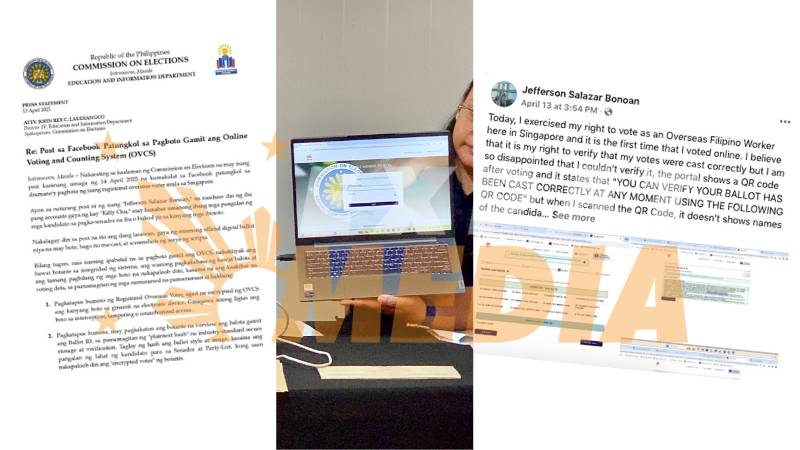
Screenshots of the post by Jefferson Salazar Bonoan and the statement from Comelec. EXPAT MEDIA
An Overseas Filipino Worker (OFW) in Singapore took to social media to voice concerns about the online voting system used in the Philippine midterm elections. In a viral post dated April 13, Jefferson Salazar Bonoan said the system showed candidates he did not vote for, sparking confusion and worry over the system’s transparency. “I exercised my right to vote as an Overseas Filipino Worker here in Singapore and it is the first time that I voted online. I believe that it is my right to verify that my votes were cast correctly, but I am so disappointed that I couldn't verify it,” Bonoan wrote. “The portal shows a QR code... but when I scanned it, it doesn’t show names of the candidates that I voted , instead it shows some names which I didn't vote ,” he added. “Unlike in the past elections, we could see receipts after inserting ballots in PCOS machines.” His post quickly circulated online, prompting a response from the Commission on Elections (Comelec). On Monday (April 14), Comelec spokesperson John Rex Laudiangco issued a detailed explanation of how the Overseas Voting Control System (OVCS) works. The official statement was shared by the Philippine Embassy in the UAE. “The voter cannot see a receipt because it may be used for vote selling or buying,” Laudiangco said in Filipino. “The encrypted system ensures secure and tamper-proof voting.” He also defended the use of Filipino overseas online voting for the first time, saying that Philippine law allows Comelec to "explore new, secure systems for overseas voting, whether electronic, paper-based, or internet-based." He also reminded the public not to trust "unverified social media posts". "We encourage OFWs to get information from official sources and allow us to address any issues directly,” he advised.How Comelec’s encrypted online voting system works
According to Comelec, here’s how the system ensures the vote is safe and properly counted: 1. Vote encryption After a voter submits their ballot, the system immediately encrypts it using industry-standard encryption. This protects the vote from interception or tampering. 2. Ballot review via QR code The QR code shown after voting allows a voter to verify that their vote was cast. However, the display includes the entire list of candidates, not just those selected, in encrypted script. This ensures secrecy and discourages vote buying. 3. Permanent record and audit trail Each ballot is given a Ballot ID and Locator, becoming a permanent and secure record of the vote. The encrypted script cannot be altered. According to Comelec, there will be post-election auditing and transparency procedures, and that ballots can be verified through ballot printing at embassies and consulates, if needed; the Election Verifier System, which checks vote accuracy; and via Random Manual Audits, where randomly selected posts manually count and match printed ballots with transmitted results. ICA/CAM/Expat Media ALSO READ: How to vote online for Philippine electionsFor all the latest news from the UAE and the world, follow us on Facebook, Twitter and Instagram and subscribe to our YouTube page










Comments
Leave a Comment