
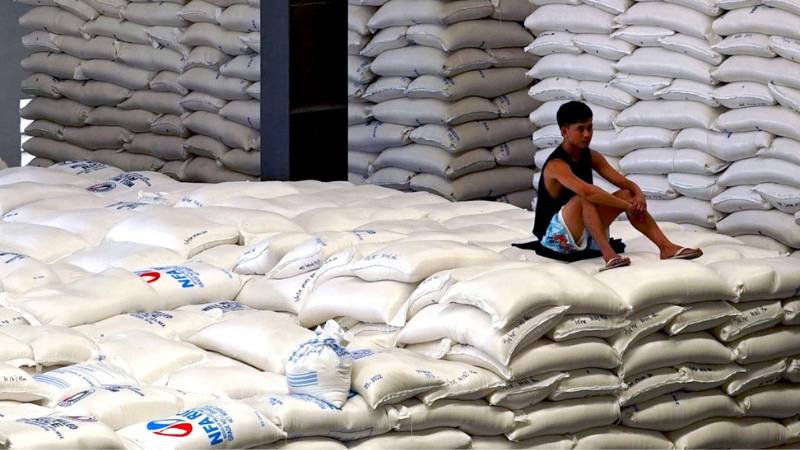
At least 600,000 sacks of rice will be distributed across Cebu, Philippines. DA
Starting May 5, the Cebu provincial government will begin selling rice at ₱20 per kilo (equivalent to Dh1.30), fulfilling one of Philippine President Ferdinand "Bongbong" Marcos Jr.’s most prominent campaign promises, said Cebu Governor Gwendolyn Garcia. Its impending rollout has sparked mixed reactions across the country. While the initiative is being lauded by many as a much-needed aid for struggling Filipino families, others remain skeptical of its timing just weeks before the May 12 midterm elections. The program, a joint initiative between the Department of Agriculture (DA), the National Food Authority (NFA), and Cebu's local government units (LGUs), aims to make rice more affordable to Filipino families. At least 600,000 sacks of rice will be distributed across Cebu, with each family allowed to purchase up to 10 kilograms per week or 40 kilograms per month, according to the DA. Cebu Governor Garcia confirmed that mayors across the province can start withdrawing rice bags immediately. “This will start on Monday, and it will be subsidized by the Cebu provincial government until December 2025,” Garcia said, adding that the national government will assume the subsidy starting next year once it is included in the national budget. The DA said that Cebu is the most prepared for the rollout. “Sila ang pinaka-ready (They are the most ready),” Agriculture Secretary Francisco Tiu Laurel Jr. told reporters. He noted that rice will be delivered in batches, with initial stocks coming from NFA warehouses in Mindoro and Iloilo. As of last week, the NFA held a five-year high buffer stock of 378,157 metric tons, equivalent to 7.56 million bags—enough to feed the nation for 10 days.However, not everyone is convinced of the program’s intentions. “Bawi sa ratings. Pero ang mga tawo ron upgraded na (It's meant to pull up their ratings, but people nowadays are upgraded),” said Kiko Arambula, a Cebu native currently working in Dubai.
Ricson Abueva Casido called it “a new form of vote buying,” while another citizen, Sy Nathanlyn, commented, “Buy the rice, but be wise in your votes. That’s just temporary to sway you during election season.”
Still, others welcomed the initiative. Local resident Marilou Cruz praised the move, saying in Filipino, "This will really help those without money. Everything is expensive nowadays.”
On questions that it might be construed as a form of electioneering, the DA confirmed it secured clearance from the Commission on Elections to proceed with the program, which will continue until 2028. The initiative not only aims to ease financial burdens for millions of Filipinos but also allows the NFA to clear warehouse space, paving the way for more palay purchases from local farmers at better prices.The P20 per kilo rice is currently priced far below market value. As of April 24, premium imported rice sells for P45 per kilo, while local premium rice ranges from P44 to P60 per kilo, according to DA’s price watch.
Despite the criticisms, the DA says it is fine-tuning the program for expansion across the country to reach more Filipinos in need. ICA/Expat Media
For all the latest news from the UAE and the world, follow us on Facebook, Twitter and Instagram and subscribe to our YouTube page










Comments
Leave a Comment