
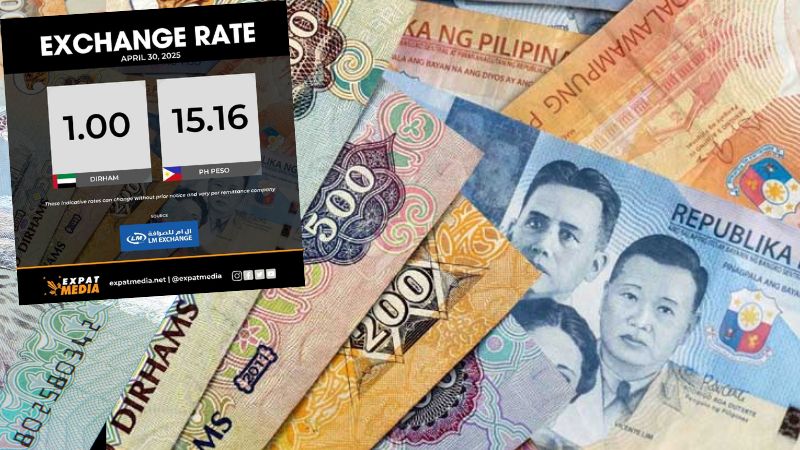
The Philippine peso and UAE dirham exchange rate on April 30, 2025. EXPAT MEDIA
On Wednesday (April 30), the Philippine peso strengthened to ₱15.16 against the UAE dirham—its highest value against the dirham in recent months—up from ₱15.59 earlier in April and late March. While many Overseas Filipino Workers (OFWs) expressed concern or confusion over what a “low” or “strong” exchange rate means, the Bangko Sentral ng Pilipinas (BSP) has offered a clear explanation of how exchange rates work and their real impact on the Philippine economy and Filipino consumers.What does a “low” peso-to-dirham rate mean?
When we say the exchange rate is “low” at ₱15.16, we mean that one UAE dirham will give you fewer pesos than before. For OFWs, this usually translates to less peso value when sending money home. In contrast, a “higher” exchange rate like ₱15.59 means more pesos per dirham. But the term “low” can be misleading. In financial terms, a stronger peso (like ₱15.16) actually means it takes fewer pesos to buy one dirham or dollar—indicating an appreciating currency. A weaker peso (like ₱15.59) means it takes more pesos to buy one dirham.Why does the exchange rate fluctuate?
According to the BSP, under the Philippines’ freely floating exchange rate system, the peso’s value is determined by supply and demand in the foreign exchange market. “The BSP does not set the foreign exchange rate but instead allows the value of the peso to be determined by market forces,” the central bank explained in its Exchange Rate Primer. If more people want to buy dollars or dirhams, the peso weakens. If more dollars or dirhams are being sold and fewer are being bought, the peso strengthens. The BSP may step in only “to temper sharp fluctuations” and to “ensure that legitimate demands for foreign currency are satisfied,” but it does not control or fix the rate.Who benefits from a strong peso?
While OFWs may get fewer pesos in remittances when the peso is strong, there are major benefits for the Philippine economy: • Lower inflation: A strong peso means imported goods, such as oil and rice, are cheaper in peso terms. • Lower debt payments: The government and businesses pay less in pesos to service foreign loans. • Stronger international reserves: The BSP can build up reserves more easily and prepay debts. • Cheaper travel abroad: For Filipinos studying, investing, or vacationing overseas, a strong peso helps. “A firm peso confers benefits to the economy—the consumers in general… importers, Filipinos who travel or invest abroad, and those who pay for foreign loans,” the BSP stated.Who benefits from a weak peso?
On the flip side, a weaker peso also brings economic advantages: • Higher OFW remittances in pesos: One dirham or dollar sends back more pesos. • Boost to exports: Philippine goods become cheaper and more competitive in foreign markets. • Increased tourism and foreign investment: The Philippines becomes a more affordable destination. However, the BSP warns that a weaker peso “can also increase inflationary pressures” due to more expensive imports.Why it matters to you
The exchange rate isn’t just a number for OFWs—it’s a barometer of the Philippine economy. The BSP uses tools such as market interventions, monetary policy, and regulations to keep volatility in check. But day-to-day changes are market-driven. Misconceptions about “low” or “high” exchange rates often depend on personal perspective. For remitters, a weaker peso feels better. But for the Philippine economy as a whole, a stronger peso has long-term advantages—particularly in controlling inflation and stabilizing debt. In short, the peso-dirham exchange rate impacts not just how much your remittance is worth, but also how much goods cost in the Philippines, how the economy grows, and how much the government pays on foreign debt. ICA/CAM/Expat MediaFor all the latest news from the UAE and the world, follow us on Facebook, Twitter and Instagram and subscribe to our YouTube page











Comments
Leave a Comment