
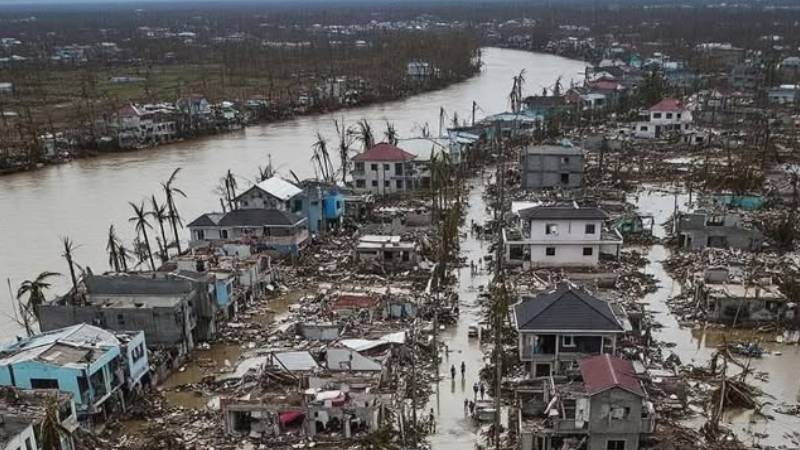
The aftermath of Typhoon Tino in Talisay City, Cebu, Philippines on November 5, 2025.
The death toll from Typhoon Tino surged past 90 on Wednesday (November 5) as rescuers combed through devastated communities in the central Philippines, where catastrophic floods submerged towns, swept away cars, and displaced hundreds of thousands of residents. Provincial officials described the flooding in Cebu as the worst in living memory, with walls of water rushing through residential areas after Tino (international name: Kalmaegi) made landfall on Tuesday (November 4) in Silago, Southern Leyte before cutting a destructive path through the Visayas. By Wednesday, the Office of Civil Defense (OCD) reported 76 deaths in Cebu province alone, many of them in the flood-hit town of Liloan. “Thirty-five bodies have been recovered from flooded areas in Liloan,” said Cebu spokesman Rhon Ramos, who added that rescue teams continue to search for missing residents in rivers and collapsed homes. Earlier, OCD Assistant Secretary Bernardo Rafaelito Alejandro IV said most fatalities were from Central Visayas. “Region 6 had one fatality, Negros Island Region had seven, and Region 7 had 50. Two deaths were in Region 8. Add the six helicopter crew members — that’s 66 confirmed deaths so far,” Alejandro said in Filipino. As of Wednesday afternoon, 26 people remained missing, including 13 each from Negros Occidental and Cebu province, according to OCD deputy spokesperson Diego Mariano.‘Unprecedented’ flooding in Cebu
Governor Pamela Baricuatro called the situation “unprecedented.” “We were expecting the winds to be the dangerous part, but the water is what’s truly putting our people at risk,” she said. “The floodwaters are just devastating.” In just 24 hours before landfall, the area around Cebu City recorded 183 millimeters of rain—far exceeding its 131 mm monthly average, said weather specialist Charmagne Varilla. By Tuesday morning, entire neighborhoods were underwater. Residents clung to rooftops as murky water surged through the streets of Cebu City, Mandaue, Talisay, and Liloan. “Around four or five in the morning, the water was so strong that you couldn’t even step outside,” said Reynaldo Vergara, 53, a shop owner who lost everything to the flood. “Nothing like this has ever happened before. The water was raging.” Councilor Dave Tumulak, head of the Cebu City Disaster Risk Reduction and Management Council, said nearly half the city’s barangays were inundated. “We had to shelter our rescue teams in malls because of strong winds. Once the storm subsided, we deployed them immediately,” he said.
Floodwaters reached second floors of homes in Barangay Bacayan’s Villa del Rio 1 subdivision, while landslides were reported in Busay. In Talisay City, entire neighborhoods near the Mananga River were wiped out.
“People marooned on rooftops were asking to be rescued, but it was impossible to reach them,” said Gwendolyn Pang, secretary-general of the Philippine Red Cross. “There were too many debris — even cars were floating.”
Councilor Dave Tumulak, head of the Cebu City Disaster Risk Reduction and Management Council, said nearly half the city’s barangays were inundated. “We had to shelter our rescue teams in malls because of strong winds. Once the storm subsided, we deployed them immediately,” he said.
Floodwaters reached second floors of homes in Barangay Bacayan’s Villa del Rio 1 subdivision, while landslides were reported in Busay. In Talisay City, entire neighborhoods near the Mananga River were wiped out.
“People marooned on rooftops were asking to be rescued, but it was impossible to reach them,” said Gwendolyn Pang, secretary-general of the Philippine Red Cross. “There were too many debris — even cars were floating.”

Wider destruction across the Visayas
Across the Visayas, Typhoon Tino’s devastation extended beyond Cebu. In Bohol, a man died after being hit by a falling tree, while in Leyte, two people drowned in the floods. Negros Island Region reported seven fatalities—one from drowning and another from falling debris, while the rest remain under investigation. More than 707,000 people or 204,000 families were affected by the storm, with 102,000 families still staying in evacuation centers as of Wednesday, according to the OCD. Ferry services and flights across the region were suspended, stranding over 3,500 passengers and causing the cancellation of at least 186 domestic flights. Power outages remained widespread across Cebu, Southern Leyte, and Negros.Military helicopter crashes amid rescue operations
Tragedy struck further when a Philippine Air Force Super Huey helicopter deployed for typhoon relief efforts crashed in Agusan del Sur on Tuesday while en route to Butuan City. “We’re waiting to confirm the identities via forensics,” said Air Force spokesperson Colonel Maria Christina Basco, confirming that six crew members — two pilots and four crew — were killed in the crash. The helicopter was among four dispatched to deliver supplies and rescue stranded residents in Mindanao’s northern coast.Climate scientists warn: storms getting stronger
Meteorologists said Typhoon Tino had sustained winds of 130 kilometers per hour and gusts of up to 180 kph as it moved westward toward Palawan on Wednesday morning. Scientists have repeatedly warned that human-induced climate change is fueling more powerful storms. Warmer oceans allow typhoons to strengthen more rapidly, while a hotter atmosphere holds more moisture — leading to heavier rainfall and flash floods. “The Philippines is hit by an average of 20 storms and typhoons each year,” said PAGASA’s Charmagne Varilla. “With Tino, we’ve already reached that number — and we’re expecting three to five more before year’s end.” The devastation comes just weeks after Super Typhoon Ragasa struck in September, killing 14 people in Taiwan and damaging infrastructure in Northern Luzon.Cebu’s long road to recovery
By Wednesday afternoon, Cebu’s streets were lined with mud and debris as residents began cleaning up. “The flood here yesterday was really severe,” said Vergara, who was salvaging what remained of his shop. “Everything was washed away.” Authorities have deployed heavy equipment to clear roads and continue to retrieve bodies in flooded communities. As Cebu reels from the aftermath, thousands remain in evacuation centers — many uncertain if their homes still stand. Governor Baricuatro vowed to push for stronger flood prevention systems. “We need to rebuild smarter,” she said. “This must never happen again.”
Summary of affected areas and damages:
• Cebu Province: 76 deaths, widespread flooding, entire barangays underwater in Cebu City, Mandaue, Talisay, Liloan; landslides in Busay; power shutdown for safety. • Southern Leyte: Provincewide blackout, homes damaged, two flood-related deaths. • Bohol: One killed by falling tree; uprooted power lines and damaged houses. • Negros Island Region: Seven dead (one drowning, one from debris); major flooding in Sagay and Bacolod. • Eastern Samar: Over 300 houses damaged on Homonhon Island. • Agusan del Sur: Six military personnel killed in helicopter crash. • National total: Over 90 confirmed dead, 26 missing, 707,000 people affected, and 102,000 families in evacuation centers. ICA/CAM/PIA/Expat MediaFor all the latest news from the UAE and the world, follow us on Facebook, Twitter and Instagram and subscribe to our YouTube page












Comments
Leave a Comment