
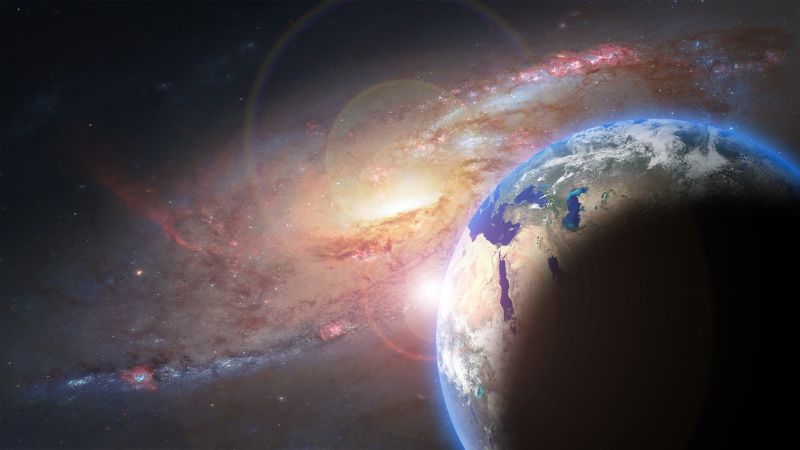
Earth and the galaxy. ARCHIVE
Skywatchers are in for a rare treat as the “Planet Parade 2025” lights up the night sky, featuring a breathtaking alignment of planets. The alignment, which started on January 21, will be best viewed on Saturday (January 25) with Venus, Mars, Jupiter, Saturn, Uranus, and Neptune. This celestial event will peak around January 29 and remain visible until mid-March, with Mercury joining the parade and adding its brilliance to the celestial lineup by late February. Mercury will reach its peak visibility from February 28 to March 12, marking the culmination of this cosmic spectacle. While the planets won’t appear in a perfectly straight line, their positions will trace the orbital plane of the solar system, creating an awe-inspiring visual. In Dubai, astronomy enthusiasts can attend a dedicated stargazing event organized by the Dubai Astronomy Group. Held at Al Qudra Desert on January 25, 26, and February 1 from 6pm to 10pm, the event offers a prime viewing experience. Tickets are priced at Dh100 for members, Dh150 for adults, and Dh120 for children. “These planetary alignments are a marvel of the cosmos. While not super rare, they are worth observing for their sheer beauty and scientific significance,” a NASA spokesperson said. Alignments like this, often referred to as a “planet parade,” occur when planets appear to line up along the ecliptic plane, the flat, disk-like region of space where they orbit the Sun. According to NASA, the current alignment isn’t perfectly straight but still offers a striking visual representation of our solar system’s geometry. While January 25 offers the best viewing opportunity, the parade will continue for two months, with Mercury’s late arrival completing the lineup. By mid-February, the configuration will begin to disperse, leaving only four visible planets. Astronomers suggest that urban light pollution may affect the visibility of fainter planets such as Uranus and Neptune. For the best experience, head to a dark-sky location like the Al Qudra Desert or a similarly remote area in the UAE. Telescopes can enhance the viewing of distant planets. The planetary parade will eventually conclude as Mercury, Venus, Mars, and Jupiter remain visible in March, while Saturn and Neptune exit the night sky. ICA/Expat MediaFor all the latest news from the UAE and the world, follow us on Facebook, Twitter and Instagram and subscribe to our YouTube page








Comments
Leave a Comment