
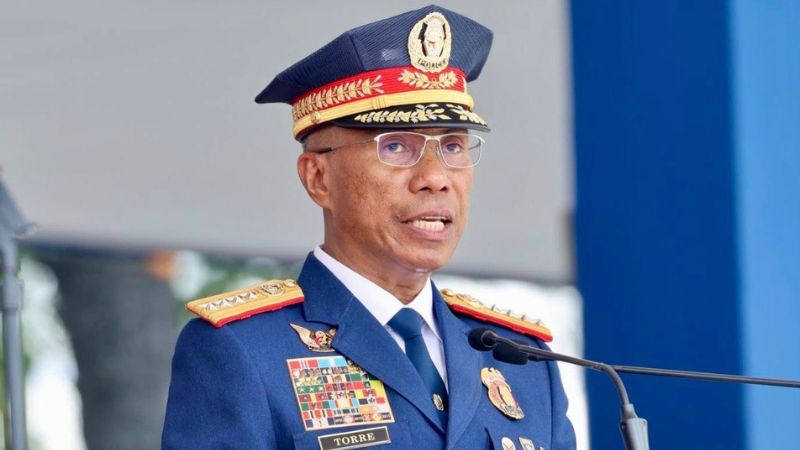
Former PNP chief Gen. Nicolas Torre. ARCHIVE
From his historic rise through the ranks in June to being unceremoniously sacked after just 85 days, the tenure of Police General Nicolas Torre III as chief of the Philippine National Police (PNP) has sparked debate across the country. On August 25, Malacañang announced Torre’s immediate relief through a memorandum signed by Executive Secretary Lucas Bersamin “upon the orders of the President.” Interior Secretary Jonvic Remulla later said Philippine President Ferdinand Marcos Jr. made a “difficult but necessary decision” to protect the integrity of the PNP and the National Police Commission (Napolcom). Marcos has so far not issud a statement on the matter. Meanwhile, Torre filed a leave of absence on August 27 while awaiting developments, leaving Filipinos questioning what really happened. Torre, appointed by the president on May 2 and formally assuming office on June 2, made history as the first PNP chief from the Philippine National Police Academy (PNPA) rather than the Philippine Military Academy (PMA). It was a stark contrast to his abrupt dismissal as the head of the PNP on August 25. So what may have led to Torre’s downfall? Expat Media looks at the five controversies that defined his short-lived leadership—plus the reforms he pushed that earned praise.1. Relieving his second-in-command
The breaking point came when Torre unilaterally reassigned his deputy, Police Lt. Gen. Jose Melencio Nartatez Jr., without clearance from Malacañang or the National Police Commission (Napolcom). The order was swiftly overturned, and Nartatez was reinstated. Former senator and ex-PNP chief Panfilo Lacson criticized Torre, saying, “Torre acted beyond his authority in unilaterally relieving his second-in-command. Even when former President Joseph Estrada gave me blanket authority to manage the PNP, I did not exercise absolute authority over Command Group designations.” In a twist of fate, Nartatez was appointed to replace Torre as PNP chief in an August 26 ceremony that Torre did not attend.2. The boxing match with Duterte’s son
In July, Torre was both cheered and mocked after accepting a perceived fistfight challenge that he turned into a charity boxing challenge against Davao City acting Mayor Sebastian Duterte, son of former Philippine president Rodrigo Duterte. The younger Duterte skipped the boxing event, and Torre was declared the winner by default. The bizarre episode drew both ridicule and applause. President Marcos even poked fun at Torre in his July 22 State of the Nation Address, jokingly calling him “the new boxing champion” alongside Manny Pacquiao and Flash Elorde. Critics, however, said the stunt diminished the PNP’s dignity.
3. Viral convoy with police sirens
A video showing Torre’s heavily escorted Land Cruiser convoy in Tuguegarao drew backlash online, with netizens calling it “overkill” and “acting like a president”. The video posted on X on August 9 showed Torre arriving in a black Land Cruiser with sirens blaring and escorted by multiple Highway Patrol and police units. Torre defended the trip as part of his official duties, which included inaugurating new PNP facilities and promoting the five-minute response policy. Still, the optics of a “VIP-style” entrance reinforced perceptions of excess and arrogance, and hurt his public image.4. Breaking tradition: First PNP chief from PNPA
Torre’s appointment itself certainly raised eyebrows as he was the first PNP chief not from the PMA. When Torre assumed office on June 2, he broke a long tradition: he was the first PNP chief who is not a PMA graduate. While historic, the appointment fueled quiet discontent within military and police circles, with critics questioning whether he could command the same institutional loyalty as his PMA-trained predecessors. While many saw this as a milestone for PNPA graduates, some insiders viewed it as a break in tradition that ruffled feathers within the police and political establishment.5. Rumored 2028 political ambitions
By mid-August, talk swirled in political circles that Torre was laying the groundwork for a 2028 presidential or vice-presidential run. Senator Imee Marcos herself said she heard reports of Torre’s classmates boasting about his political plans. “His classmates are bragging about his plans to run for president or vice president in 2028,” she said, warning that it was “embarrassing” for the rift between Torre and the DILG to become public. Rumors of early political ambition—especially by a uniformed officer—may have been one controversy too many for Malacañang.What Torre did right in 3 months
Before his official appointment in May, Torre already made headlines by leading high-profile arrests, notably the enforcement of a controversial arrest warrant for former president Rodrigo Duterte and the arrest of televangelist Apollo Quiboloy. Despite the controversies, Torre did push through reforms and initiatives during his brief leadership: • Police reforms – He introduced a five-minute response policy for police operations and emphasized the “5Cs” (command, communicate, coordinate, collaborate, control). • Human rights coordination – Torre pushed closer collaboration with the Commission on Human Rights in the state’s anti-illegal drug campaign, marking a shift from past administrations. • Crackdown on disinformation – Under his watch, the PNP exposed a social media disinformation campaign that used misleading clips to paint a picture of lawlessness under the Marcos government. He ordered crackdowns on fake news pages spreading false claims of lawlessness under the Marcos government. With his removal, Torre joins the ranks of the shortest-serving PNP chiefs in history. Lt. Gen. Jose Melencio Nartatez Jr. has been named his successor. Whether Torre’s fall was due to power struggles, political missteps, or genuine overreach remains debated—but his 85-day tenure is likely to be studied for years. CAM/ICA/PIA/Expat MediaFor all the latest news from the UAE and the world, follow us on Facebook, Twitter and Instagram and subscribe to our YouTube page







Comments
Leave a Comment