
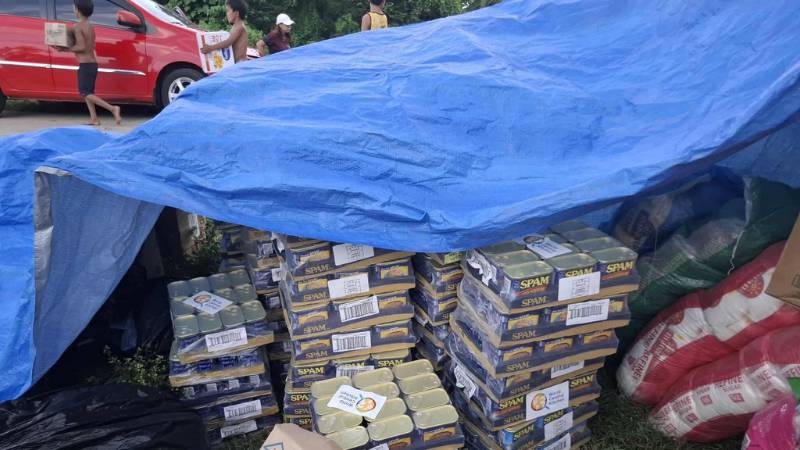
The stock of Spam donated to quake victims in Bogo City, Cebu. MAYEL MARTINEZ
Canned Spam, PediaSure, Wilkins bottled water, and jasmine rice — these are not your typical relief goods, but for earthquake-hit residents in Cebu, they became symbols of compassion served with care. Photos shared by Bogo City Mayor Mayel Martinez went viral over the weekend, showing an impressive haul of branded food items stacked in Barangay Polambato. “The relief goods here in Polambato Purok Ginsaw are classy — there’s Spam, PediaSure, jasmine rice, Wilkins water, fruit cocktail, mamon, Century Tuna, dried mangoes, Oreo, and Dutch Mill,” Martinez wrote in Cebuano, expressing amazement at the quality of the aid. The donation came from World Central Kitchen (WCK), a global non-profit. WCK is known for its on-the-ground food relief efforts in disaster-stricken areas, from earthquake zones in Haiti to war-torn Ukraine — and now, in northern Cebu. Residents in Bogo City expressed gratitude, saying that even the quality of aid reflected care and respect. “It’s not just food; it feels like they value us as people,” a resident said in Cebuano. But beyond the viral images of branded aid lies a quieter story of solidarity — one where there is no distinction between rich or poor. Across Cebu, private individuals and civic groups have joined government relief efforts, packing their cars and trucks with everything from bottled water and rice to sleeping foams and tarpaulin tents. Some repacked boxes of canned goods from their own pantries. Others filled grocery carts to the brim and personally drove hours through traffic to deliver aid to remote areas. In one video shared on social media, a group was seen handing out their fresh catch of fish to residents in an isolated barangay, refusing any payment. Another clip showed a family converting their garage into a mini relief hub, labeling packs of noodles and biscuits to send north. “People are giving whatever they have,” a volunteer from Lapu-Lapu City told Expat Media. “You’ll see SUVs beside motorcycles, all loaded with donations. Everyone just wants to help.” The earthquake left at least 72 people dead, hundreds injured, and thousands displaced. Families in hard-hit barangays were forced into makeshift shelters, cemeteries, and roadside encampments as aftershocks kept them from returning to their homes. Yet amid the devastation, a powerful story unfolded—one of Filipino resilience and bayanihan. One image that captured the nation’s heart came from volunteer Jennivieve Abelgas Caminero, who shared how an elderly man in worn clothes and carrying a sack came to their donation site. Despite his circumstances, he pulled out ₱19 in coins—the little he had—to contribute. “The volunteers cried after Tatay left. We weren’t supposed to accept cash, but we couldn’t turn him down. Tatay even asked if we’d still be here on Monday because he wanted to collect old T-shirts to donate,” Caminero wrote in Cebuano in her now-viral post. This quiet act of generosity set the tone for countless others. Across social media, videos showed private citizens loading groceries, bottled water, rice and food packs into cars and trucks to deliver directly to quake-hit towns. Traffic slowed on roads leading to Bogo City as convoys of personal vehicles joined government and NGO trucks headed north.
Some survivors like Daniela Pepito from Sitio Takdan 2 in Bogo shared their frustration and gratitude in equal measure: “Any help will do, even just for the children. Many households are here, but we feel forgotten compared to those along the main roads.”
To fill that gap, families of residents in remote barangays turned to Facebook to plead for help, sparking waves of independent volunteer missions. Some private donors pressed on with aid efforts even late at night, quietly leaving packs of bottled water along roadsides where there are sleeping evacuees. Others brought fresh fish and rice to families who had lost everything.
In San Remigio and Tabogon, residents were even seen offering bananas and sweet potatoes in exchange for drinking water—though donors often refused to take anything in return. Neighbouring cities and municipalities inside and outside Cebu, and their residents also showed up to help, including Cebu City, Maribago, Danao City, Mandaue City and Talisay City in Cebu, as well as Davao City, Zamboanga City, South Cotabatao and many others that sent truckloads of aid.
While Governor Pamela Baricuatro acknowledged the overwhelming generosity, she also appealed for coordination. “We appreciate the overwhelming support, but we ask private individuals and organizations to centralize the donations. It is not advisable for everyone to go there and do their own distribution,” Baricuatro said, stressing that local governments were also quake victims.
Despite the appeal, many volunteers pressed on, determined to bring supplies directly to families still waiting for relief in far-flung areas. Their efforts were reinforced by civic groups, churches, and businesses, which launched aid caravans aligned with government response centers.
Meanwhile, hundreds of university students volunteered to pack goods and assist in shelters, while medical personnel offered free check-ups, trauma care, and first aid to displaced families. The Cebu Chamber of Commerce & Industry, Rotary International, JCI, and church groups pledged long-term support.
As Dr. Nikki Catalan, a provincial health consultant, put it: “Together, government, private institutions, and civic organizations stand united in restoring communities, rebuilding livelihoods, and strengthening resilience for Northern Cebu.”
In Cebu, it isn’t just the big organizations making an impact — it’s the countless nameless donors, families, and volunteers whose small acts of giving ripple through every town.
For every imported can of Spam sent, there’s a fisherman giving his fresh catch. For every bottle of Wilkins water donated, there’s a student handing out cups of coffee to tired responders. Together, they are showing the world that kindness is the real luxury. PIA/CAM/ICA/Expat Media
This quiet act of generosity set the tone for countless others. Across social media, videos showed private citizens loading groceries, bottled water, rice and food packs into cars and trucks to deliver directly to quake-hit towns. Traffic slowed on roads leading to Bogo City as convoys of personal vehicles joined government and NGO trucks headed north.
Some survivors like Daniela Pepito from Sitio Takdan 2 in Bogo shared their frustration and gratitude in equal measure: “Any help will do, even just for the children. Many households are here, but we feel forgotten compared to those along the main roads.”
To fill that gap, families of residents in remote barangays turned to Facebook to plead for help, sparking waves of independent volunteer missions. Some private donors pressed on with aid efforts even late at night, quietly leaving packs of bottled water along roadsides where there are sleeping evacuees. Others brought fresh fish and rice to families who had lost everything.
In San Remigio and Tabogon, residents were even seen offering bananas and sweet potatoes in exchange for drinking water—though donors often refused to take anything in return. Neighbouring cities and municipalities inside and outside Cebu, and their residents also showed up to help, including Cebu City, Maribago, Danao City, Mandaue City and Talisay City in Cebu, as well as Davao City, Zamboanga City, South Cotabatao and many others that sent truckloads of aid.
While Governor Pamela Baricuatro acknowledged the overwhelming generosity, she also appealed for coordination. “We appreciate the overwhelming support, but we ask private individuals and organizations to centralize the donations. It is not advisable for everyone to go there and do their own distribution,” Baricuatro said, stressing that local governments were also quake victims.
Despite the appeal, many volunteers pressed on, determined to bring supplies directly to families still waiting for relief in far-flung areas. Their efforts were reinforced by civic groups, churches, and businesses, which launched aid caravans aligned with government response centers.
Meanwhile, hundreds of university students volunteered to pack goods and assist in shelters, while medical personnel offered free check-ups, trauma care, and first aid to displaced families. The Cebu Chamber of Commerce & Industry, Rotary International, JCI, and church groups pledged long-term support.
As Dr. Nikki Catalan, a provincial health consultant, put it: “Together, government, private institutions, and civic organizations stand united in restoring communities, rebuilding livelihoods, and strengthening resilience for Northern Cebu.”
In Cebu, it isn’t just the big organizations making an impact — it’s the countless nameless donors, families, and volunteers whose small acts of giving ripple through every town.
For every imported can of Spam sent, there’s a fisherman giving his fresh catch. For every bottle of Wilkins water donated, there’s a student handing out cups of coffee to tired responders. Together, they are showing the world that kindness is the real luxury. PIA/CAM/ICA/Expat Media
View this post on Instagram
For all the latest news from the UAE and the world, follow us on Facebook, Twitter and Instagram and subscribe to our YouTube page





Comments
Leave a Comment