
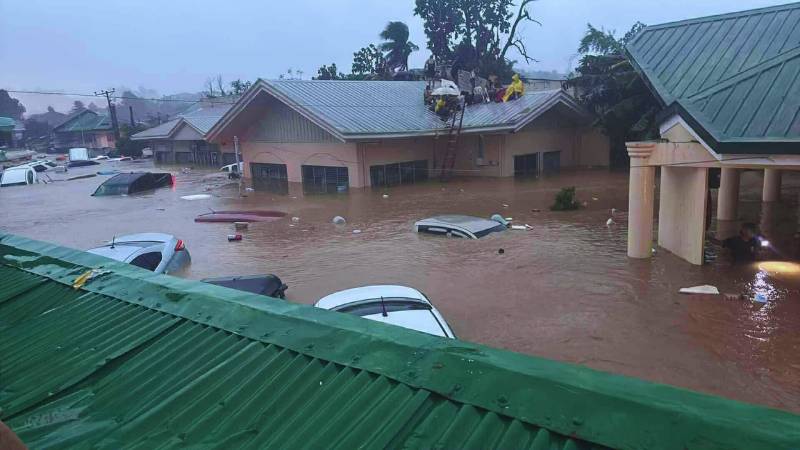
Houses are submerged in Cebu City, Philippines on November 4, 2025 in the onslaught of Typhoon Tino. PIOLO GALLARDO
Typhoon Tino (international name: Kalmaegi) barreled across the central Philippines early Tuesday (November 4), leaving at least two people dead and tens of thousands displaced as flash floods engulfed homes and vehicles across the Visayas region. The storm, packing winds of up to 150 kilometers per hour and gusts reaching 205 kph, made landfall around midnight in Silago, Southern Leyte before moving westward toward Cebu and Negros. By mid-morning, it was hovering near Sagay City in Negros Occidental. An elderly resident in Southern Leyte drowned after being trapped on the upper floor of a flooded home, according to disaster official Danilo Atienza. In Bohol, another villager died after being struck by a falling tree. “The senior citizen was trapped on an upper floor and unable to get assistance,” Atienza told radio outlet DZMM. At least six people were confirmed missing in in Barangay Bacayan, Cebu City after being swept away by the heavy floods, said Mayor Nestor Archival.Cebu submerged, people marooned on rooftops
In Cebu, residents scrambled to rooftops as floodwaters rose rapidly overnight. “We have received so many calls from people asking us to rescue them from roofs and from their houses, but it’s impossible,” said Gwendolyn Pang, secretary-general of the Philippine Red Cross. “There are so many debris, you see cars floating so we have to wait for the flood to subside.” Cebu City’s Barangay Bacayan, particularly Villa del Rio 1 subdivision, was among the hardest hit, with floodwaters reaching second-floor levels. Councilor Winston Pepito, who lives in the area, went live on Facebook as residents sought refuge on rooftops. Nearby Barangay Buot-Taup, Talamban, and Basak Pardo were also severely inundated, while landslides were reported in Busay. In Talisay City, water reached as high as rooftops in Palm River Subdivision, trapping residents in two-storey homes. “During the height of the typhoon, we had to keep our rescue teams inside malls for their safety because the winds were too strong,” said Councilor Dave Tumulak, head of the Cebu City Disaster Risk Reduction and Management Council. “After the winds subsided, we immediately deployed them to the most affected barangays.” Tumulak confirmed that individuals were swept away by floodwaters and several casualties were being recovered. The Philippine Coast Guard has been called to monitor coastal areas for missing persons. In Mandaue City, floodwaters reached as high as people’s heads, while in Talisay City, waters engulfed homes in Palm River Subdivision and Pueblo San Ricardo, trapping residents on second floors. “By 4am, the flooding was already uncontrollable. People couldn’t get out of their houses,” said resident Don del Rosario, 28, who sought refuge on an upper floor. “I’ve been here for 28 years, and this is by far the worst we’ve experienced.” Across the region, more than 387,000 people have been displaced from their homes, according to the Office of Civil Defense.
Power cut, rescues ongoing
Half of Cebu City’s barangays were affected by widespread flooding, forcing the city government to shut down electricity at 4:30am for safety reasons. “I was the one who requested the shutdown of power to ensure the safety of residents,” Tumulak said, adding that Visayan Electric Company is inspecting lines before restoring power. More than 1,374 families comprising of 5,005 individuals in Cebu’s northern district, and 3,189 families comprising of 12,070 individuals in the south have sought refuge in 61 evacuation centers, where relief packs and food have been distributed by the Department of Social Welfare and Services. Cebu City Mayor Nestor Archival ordered all departments to maintain 24-hour operations as the city remains under red alert. “We were shocked by the extent of the flooding, especially in areas like Barangay Babag, where this kind of overflow has never happened before,” Tumulak said.Wider devastation across Visayas
In Southern Leyte, the storm knocked out power across the province. In Eastern Samar, fierce winds damaged more than 300 homes on the island of Homonhon, part of Guiuan town. “There was no flooding at all, but just strong wind,” said Mayor Annaliza Gonzales Kwan. “We’re okay. We’ll make this through. We’ve been through a lot—and bigger than this.” In Negros Island, officials warned residents living near Mount Kanlaon of possible volcanic mudflows due to heavy rains. Ferry operations across central Visayas were suspended, stranding over 3,500 passengers and truck drivers, while 186 flights were canceled nationwide. The Philippine Atmospheric, Geophysical and Astronomical Services Administration (PAGASA) said Typhoon Tino — the 20th storm to hit the Philippines this year — is expected to exit into the South China Sea by early Wednesday. “This typhoon is one of the strongest this year,” said Cebu Provincial Disaster Risk Reduction head Dennis Pastor. “We continue to monitor and deploy rescue operations throughout the province.”Summary of affected areas and damages
Cebu City – Widespread flooding in at least 50 percent of barangays. Hardest hit were Barangays Talamban, Bacayan, Basak Pardo, Buot-Taup, and Babag. Floodwaters reached up to second floors in several subdivisions. Landslides reported in Busay. Power was shut off citywide for safety; thousands evacuated to over 60 centers. At least six people missing in Barangay Bacayan. Mandaue City, Cebu – Streets submerged near Maayo Hotel and UN Avenue; several vehicles floated or were fully submerged. Many residents trapped in flooded homes. Talisay City, Cebu – Flooding reached rooftops in Palm River and Pueblo San Ricardo subdivisions; rescue teams deployed. Consolacion and Danao City, northern Cebu – Flooding reported in Galaxy Danglag and in front of Danao Provincial Hospital; residents appealed online for rescue. Southern Leyte – Elderly villager drowned; provincewide blackout reported after Tino made landfall in Silago. Bohol province – One person killed by a fallen tree; several towns experienced power loss and toppled trees. Eastern Samar (Guiuan, Homonhon Island) – Around 300 houses damaged or destroyed by strong winds; no casualties. Negros Occidental – Bacolod and Sagay City experienced heavy rains and strong winds as the typhoon’s center moved through. Dinagat Islands – Houses damaged by strong winds during first landfall; power outages and flooding reported. Nationwide impact – Over 387,000 people displaced, 3,500 stranded at seaports, 186 flights canceled, and widespread power interruptions across central and eastern Visayas. ICA/CAM/PIA/Expat MediaFor all the latest news from the UAE and the world, follow us on Facebook, Twitter and Instagram and subscribe to our YouTube page












Comments
Leave a Comment