
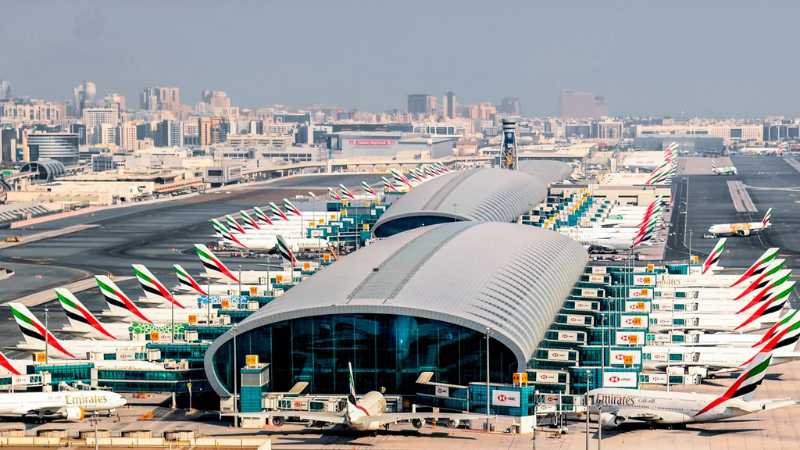
At the Dubai International Airport. ARCHIVE
The UAE has activated its emergency airport operations plan in response to the escalating conflict between Iran and Israel, which has caused major airspace closures and widespread travel disruptions. The Federal Authority for Identity, Citizenship, Customs, and Port Security (ICP) announced on Tuesday (June 17) that it is working in full coordination with airport and airline authorities to maintain operational readiness and ensure passenger safety. “The approved emergency business continuity plan was activated immediately to ensure flexibility and minimize travel disruption,” the ICP said. The plan includes round-the-clock staffing, real-time coordination with airline operators, and the provision of logistical support for affected passengers. With key regional airspaces closing and concerns of further conflict escalating, UAE airports have deployed additional personnel to guide passengers, provide accommodation and updates, and assist with rescheduling. Dubai and Abu Dhabi airports have urged passengers to stay informed via airline channels as flight schedules remain fluid. The travel crisis stems from an ongoing armed conflict between Israel and Iran, which entered its sixth day on Wednesday (June 18). The two nations have exchanged waves of missile strikes, hitting civilian and infrastructure targets, and killing hundreds. In response to the volatility, UAE carriers have made sweeping changes: • Emirates Airline has suspended flights to Tehran, Baghdad, and Basra until June 30, and to Amman and Beirut until June 22. • Etihad Airways has cancelled flights to and from Tel Aviv until June 22 and is rerouting other flights due to restricted airspace. • flydubai has suspended all flights to Iran, Iraq, Israel, and Syria until June 30. • Air Arabia has also halted operations to Lebanon, Jordan, Russia, Iran, and Iraq, with suspensions ranging from June 16 to June 30. Passengers with onward connections to these destinations are being denied boarding at their point of origin, according to airline advisories. “Guests transiting through Abu Dhabi to connect to cancelled flights will not be accepted for travel from their point of origin,” Etihad Airways confirmed. Analysts have raised concerns about growing risks to global aviation, with thousands of daily flights across Middle Eastern airspace now needing rerouting — increasing fuel consumption, delaying schedules, and impacting profitability. Osprey Flight Solutions warned that airlines are navigating an increasingly volatile geopolitical environment. Eurocontrol data shows that about 1,400 flights pass through Middle Eastern airspace daily, underscoring the ripple effect of regional airspace closures. The UAE’s Ministry of Foreign Affairs has also issued a travel advisory, urging citizens and residents to avoid travelling to high-risk zones and register with Twajudi, the emergency repatriation system. As the conflict continues to unfold, stakeholders remain on high alert, with global leaders calling for de-escalation to avoid a broader crisis that could threaten trade, aviation, and economic stability in the region. ICA/Expat Media ALSO READ: Senator calls for evacuation plan for Filipinos in Middle EastFor all the latest news from the UAE and the world, follow us on Facebook, Twitter and Instagram and subscribe to our YouTube page












Comments
Leave a Comment