
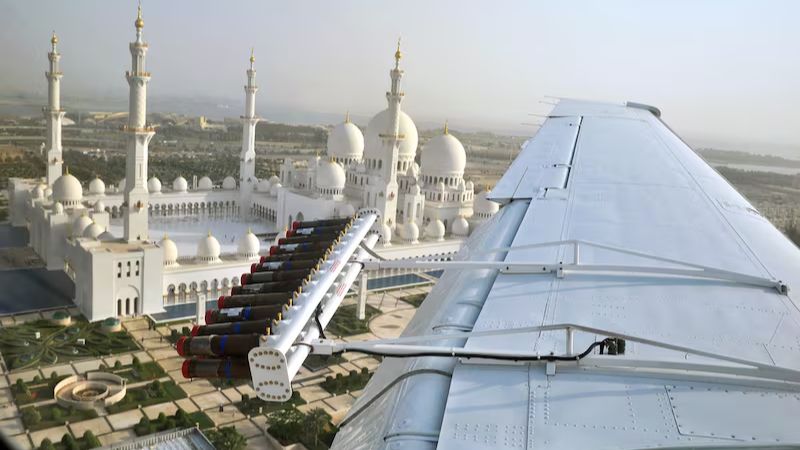
A cloud-seeding operation over the Sheikh Zayed Grand Mosque in Abu Dhabi. NCM
The UAE has awarded up to $1.5 million each to three international scientists to support advanced research into cloud seeding and rain enhancement, as part of the country’s long-term efforts to strengthen water security. The grants were announced on Wednesday (January 21) under the sixth cycle of the UAE Research Programme for Rain Enhancement Science, run by the National Centre of Meteorology (NCM). The winning projects were selected from 140 research proposals submitted by scientists from 48 countries. Each project will be funded over three years, with a maximum annual allocation of $550,000. The selected researchers are Dr Michael Dixon, principal radar meteorologist at Echo Science Works in the United States; Prof Linda Zou, adjunct professor at Victoria University in Australia; and Dr Oliver Branch, senior scientist at the University of Hohenheim in Germany. All three projects will include research activities conducted in the UAE. The UAE launched its cloud seeding programme decades ago to address water scarcity, later establishing the dedicated research programme in 2015 to drive scientific innovation in rain enhancement. Speaking at the announcement in Abu Dhabi, Abdulla Al Mandous, Director General of the NCM, highlighted the growing role of artificial intelligence in the field. “We are developing the next generation of solutions to make rain enhancement more efficient and sustainable than ever before,” he said. “We are turning our vision into reality by making the UAE the global home for rain enhancement.” Dr Dixon’s project focuses on improving how cloud seeding is evaluated by upgrading radar systems to observe detailed microphysical changes inside clouds. The project will integrate AI to help identify the most suitable storms for seeding and includes training programmes for Emirati scientists. Prof Zou’s research aims to develop new cloud seeding agents using advanced nanocomposite materials such as graphene. These materials could prove more effective and environmentally friendly than traditional agents like silver iodide, with AI guiding their design and testing. Dr Branch’s project explores whether modifying land surfaces, such as engineering sand dunes to influence wind patterns, could help create conditions that encourage rainfall. The research will involve close collaboration with the NCM and Khalifa University. Water security remains a critical challenge for the UAE, which receives less than 100 millimetres of rainfall annually and relies heavily on desalination. The importance of sustainable water solutions will also be highlighted at the 2026 UN Water Conference, which the UAE will co-host with Senegal in the Emirates this December. Alya Al Mazrouei, Director of the UAE Research Programme for Rain Enhancement Science, said climate change has made the challenge even more urgent. “Water security remains one of the most pressing global challenges, especially in light of accelerating climate change,” she said. “For arid and semi-arid regions like ours, this reality underscores the urgency of securing sustainable water supplies.” Since its launch in 2015, the programme has awarded nearly $25 million in research funding, secured 10 patents, and supported scientific advances in rain enhancement worldwide. ICA/Expat MediaFor all the latest news from the UAE and the world, follow us on Facebook, Twitter and Instagram and subscribe to our YouTube page








Comments
Leave a Comment