
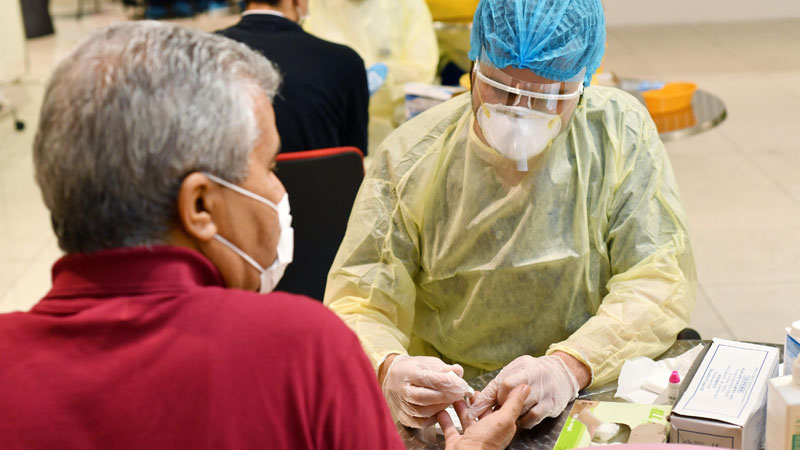
UAE conducts Covid-19 genome sequencing to understand virus
DUBAI – Researchers and scientists in the UAE have conducted more than 588 studies, including the country’s first full genome sequencing of Covid-19 to understand the nature of the coronavirus. "These studies are looking into ways of simulating the spread of the disease and the movement of patients and the psychological and health impact of the virus on society," said Dr. Alawi Al Sheikh, the spokesman for the advanced science sector. Al Sheikh said that scientists from Mohammed Bin Rashid University of Medicine and Health Sciences (MBRU) conducted the UAE's first full genome sequencing of the Covid-19, which will help scientists understand how it spreads. "The study aims to fully sequence viral samples from 240 patients with Covid-19 across various age groups and at different points of this pandemic," he said.Genetics of Covid-19 patients under study
Al Sheikh said that researchers and scientists in the UAE have also conducted a study on the genetic factors of Covid-19 patients. The study aims to understand the genetic factors that lead to the discrepancy in the severity of infections between patients in the country by studying patients' full genome sequencing, he said. Participating in the study are experts from Khalifa University, UAE University, Sharjah University, and the health departments of Abu Dhabi and Dubai, as well as the University of Western Australia and Al Ain Centre for Fertility. "It is important to understand the impact of Covid-19 on people with chronic disease and smokers in order to develop precautionary plans to ensure their safety. Therefore, a team from UAE University will study factors that make some cases more critical than others to help reduce fatalities," Al Sheikh said. "The study has illustrated that Covid-19 is a virus transmitted by animals to humans. A team of specialists from Khalifa University is now collaborating with UAE University and a number of global colleges, such as one in Florida and the Chinese Institute for Agricultural Sciences, Murdoch University, and University of Western Australia, to look into how an animal virus has been transmitted to humans.New devices to accelerate Covid-19 screenings
Al Sheikh said that a team from Khalifa University is working on two projects: the first to accelerate screenings by developing devices that require less time than the internationally recognized PCR tests. He added that researchers from Khalifa University have also developed a simple, cost-effective device for effective artificial respiration in emergencies. The new device uses 3D printing techniques to meet the growing demand for artificial respirators. "The new device can be further developed on a wider scope, which means that more can be produced at a lower cost to meet growing demand," Al Sheikh said. ICA/Expat MediaFor all the latest news from the UAE and the world, follow us on Facebook, Twitter and Instagram and subscribe to our YouTube pageJTNDc2NyaXB0JTIwc3JjJTNEJTIyJTJGJTJGcGFnZWFkMi5nb29nbGVzeW5kaWNhdGlvbi5jb20lMkZwYWdlYWQlMkZqcyUyRmFkc2J5Z29vZ2xlLmpzJTIyJTIwYXN5bmMlM0QlMjIlMjIlM0UlM0MlMkZzY3JpcHQlM0UlMEElMjAlM0MlMjEtLSUyMGluLWFydGljbGUlMjBhZCUyMC0tJTNFJTBBJTIwJTNDaW5zJTIwY2xhc3MlM0QlMjJhZHNieWdvb2dsZSUyMiUyMHN0eWxlJTNEJTIyZGlzcGxheSUzQSUyMGJsb2NrJTNCJTIyJTIwZGF0YS1hZC1jbGllbnQlM0QlMjJjYS1wdWItNTAwNjI0MTU4MzU4MTg0OSUyMiUyMGRhdGEtYWQtc2xvdCUzRCUyMjg1MjYwOTM2MTElMjIlMjBkYXRhLWFkLWZvcm1hdCUzRCUyMmF1dG8lMjIlM0UlM0MlMkZpbnMlM0UlMEElM0NzY3JpcHQlM0UlMkYlMkYlMjAlM0MlMjElNUJDREFUQSU1QiUwQSUyOGFkc2J5Z29vZ2xlJTIwJTNEJTIwd2luZG93LmFkc2J5Z29vZ2xlJTIwJTdDJTdDJTIwJTVCJTVEJTI5LnB1c2glMjglN0IlN0QlMjklM0IlMEElMkYlMkYlMjAlNUQlNUQlM0UlM0MlMkZzY3JpcHQlM0UlMEE=












Comments
Leave a Comment