
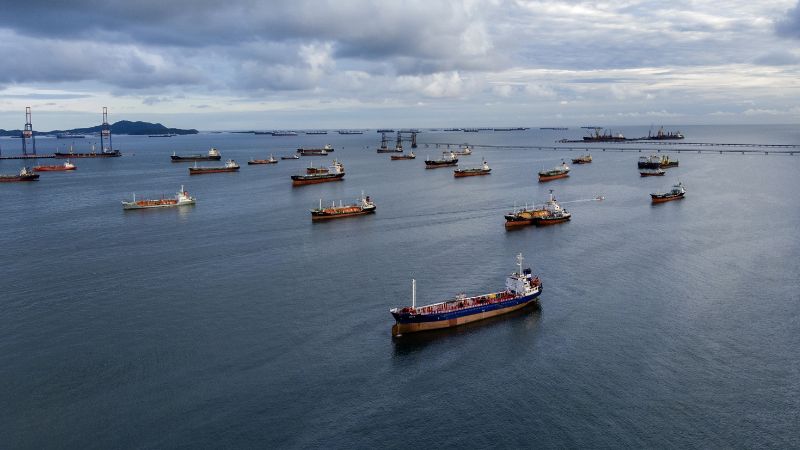
A bird's eye view of the Strait of Hormuz. ARCHIVE
The UAE has announced an ambitious long-term strategy to eliminate its dependence on the Strait of Hormuz by expanding eastern ports, building new transport infrastructure and increasing export capacity through the Gulf of Oman. The plan was revealed by Dr. Thani bin Ahmed Al Zeyoudi, Minister of State for Foreign Trade, who said the UAE is moving toward a future in which its energy and trade exports can continue uninterrupted regardless of developments in the strategic waterway. “We’re moving towards having zero Hormuz dependency and that’s regardless of whether it’s open or not,” Al Zeyoudi said. “It’s going to open and we hope that will happen quickly, but we will not stop the new plan.” The Strait of Hormuz remains one of the world's most important energy chokepoints, with roughly one-fifth of global oil and energy shipments passing through the narrow waterway. Recent regional tensions have renewed concerns over disruptions to shipping routes and global supply chains.Major expansion of eastern ports
At the heart of the UAE’s strategy is a significant expansion of its eastern coast ports along the Gulf of Oman, including Dibba, Fujairah and Khor Fakkan. The government is also planning to build at least one new harbour on the eastern seaboard as part of efforts to create alternative export routes that bypass the Strait of Hormuz entirely. The initiative is expected to strengthen the UAE’s position as a global logistics hub while improving the resilience of its trade and energy sectors. In addition to port expansions, the UAE plans to develop new pipeline, rail and road networks connecting eastern ports with the country’s oilfields, gasfields and processing facilities. The strategy builds on the existing Habshan-Fujairah pipeline, which currently enables Abu Dhabi crude oil exports to bypass the Strait of Hormuz. In May, the UAE announced plans to accelerate construction of a second pipeline that would double crude export capacity through Fujairah. Authorities are also studying a third petroleum pipeline and additional logistics corridors to support future growth. “The direction is already there, we’re doing the whole feasibility studies to move on,” Al Zeyoudi said. “During those tough times, you always identify your gaps and you start working on it.”Petrochemical and LNG exports
The UAE is also exploring ways to ensure uninterrupted exports of petrochemicals, liquefied natural gas (LNG) and other energy products through eastern coastal facilities. Plans reportedly include dedicated petrochemical and LNG export hubs that would allow products to reach international markets without passing through the Arabian Gulf. The strategy aligns with broader efforts to strengthen economic resilience and diversify logistics routes amid growing geopolitical uncertainty. Al Zeyoudi said the UAE's infrastructure investments are intended to ensure continuity of trade and exports under all circumstances. The government has also allocated Dh1 billion to support small and medium-sized enterprises (SMEs) facing supply chain challenges and disruptions. While no official timeline or total project cost has been announced, officials said feasibility studies are underway and significant investments are expected as the plan moves forward. PIA/CAM/Expat MediaFor all the latest news from the UAE and the world, follow us on Facebook, Twitter and Instagram and subscribe to our YouTube page








Comments
Leave a Comment