
Picture for illustrative purposes only. ARCHIVE
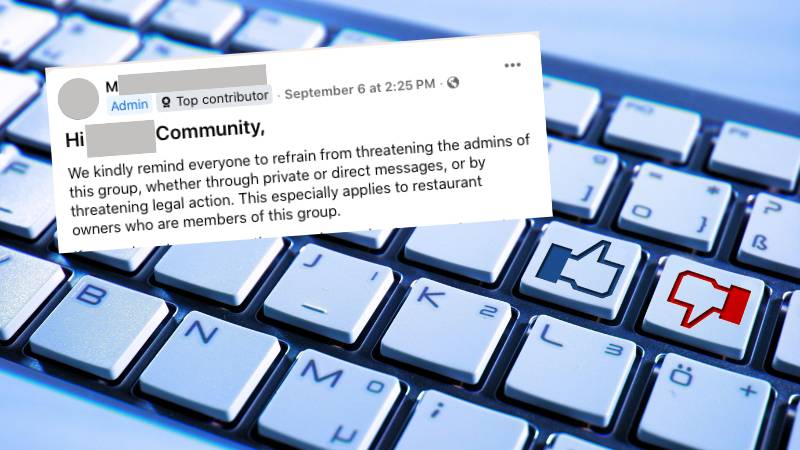
A Facebook food review group in the UAE has warned restaurant operators against threatening members and administrators over negative posts, sparking fresh debate on where to draw the line between customer feedback and defamation under the country’s strict cybercrime laws. Michael C., the group’s administrator and a Dubai-based creative director, said his team has received threats after members shared negative food reviews. “We kindly remind everyone to refrain from threatening the admins of this group, whether through private or direct messages, or by threatening legal action. This especially applies to restaurant owners who are members of this group,” he wrote in a public post. He stressed that the platform allows members to freely share their experiences, adding: “If a member shares a negative experience about your restaurant, please understand that the admin team is not responsible for that experience. This is an open, public platform where members are free to share feedback.” The post drew strong reactions from group members. “Please stop threatening the group members thru PM, DM and by legal action too!” wrote Marie. “This is an open and public platform where members are free to share our feedback.” Another member, Pao, noted: “The problem with some consumers is instead of addressing the business directly, they will post it here immediately. For business owners, they should be open to criticism for them to improve.” Long-time hospitality worker Dina Jane said, “We take negative feedback to improve. We may also give the customer a free meal or a discounted meal to change their negative experience.”Legal risks of online reviews
The issue comes amid heightened awareness of the UAE’s Federal Decree Law on Combatting Rumors and Cybercrimes, which treats defamatory or damaging statements online as criminal offenses. Speaking to Expat Media, a Dubai salon manager recalled how a Google review turned into a police case after a customer accused her by name and posted her photo. “She claimed we didn’t give her proper service and that I was rude,” the manager said. “The police checked the review and told me that people must not target individuals or name them.” The client was ultimately told by police to delete the review or face a fine. In 2024, a British man faced a lawsuit in the UAE after he wrote a Google review criticizing his employer. Craig Ballentine, who was employed at a Dubai-based dog grooming business, posted a negative review following what he described as a difficult work experience. The review, which included comments about his treatment at work, was at the center of a legal battle under the UAE’s strict anti-cybercrime laws that left Ballentine detained in the UAE for months while the case was ongoing. According to the law, individuals found guilty of defamatory statements can face fines of up to Dh20,000 and detention of up to one year. For online defamation, the punishment increases to between Dh250,000 to Dh500,000 and imprisonment of up to two years. Penalties can also include deportation for expatriates. Even seemingly honest opinions may cross legal boundaries if they damage reputations.What the law says
Defamation under UAE law can be classified as libel (written) or slander (spoken). Libel includes defamatory comments made online, in photos, or even through memes. Abdulla U.C., legal consultant of FranGulf Legal and Business Consultants, told Expat Media: “Undoubtedly, the criminal laws of the UAE are so stringent and vigorous that any anonymous comment on any social media platform will open gates for various criminal charges against the alleged.” He added: “We all have the freedom to voice our thoughts. However, the UAE government has set out certain restrictions for the freedom of speech, violating which will land you in trouble. There must be a balance between the right to protect one’s personal status and the freedom of speech one can enjoy.” Authorities advise customers to use official complaint channels to avoid potential legal issues, while encouraging businesses to see negative feedback as opportunities to improve. As one food group member summed it up: “At the end of the day, we all want the same thing — better experiences for customers and a community that stays respectful and constructive.”What you can do safely if you want to complain in the UAE
Speaking to Expat Media, experts recommend the following for UAE residents to avoid potential legal issues while still making their voice heard: • Use official channels first: File a complaint with the Department of Economic Development (DED), Dubai Municipality, or the relevant consumer protection authority. • Keep it factual: Stick to facts without exaggeration or personal attacks. Also, avoid making unverified accusations of illegal activities or unethical behavior by a business. • Avoid naming individuals: Mentioning staff names or posting photos without consent can be considered defamation. • Stay respectful: Offensive or abusive language could make your complaint a legal case. • Document issues: Keep receipts, photos of food, or communication records as evidence if needed. • Keep private info private: Do not share private information about an individual or business without consent. This approach ensures that complaints are handled professionally and within the legal framework, protecting both the complainant and the subject of the complaint. ICA/CAM/Expat MediaFor all the latest news from the UAE and the world, follow us on Facebook, Twitter and Instagram and subscribe to our YouTube page












Comments
Leave a Comment