
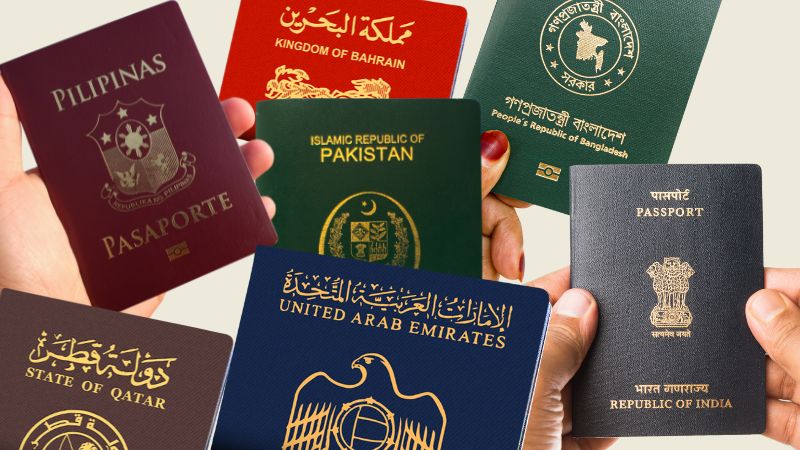
Picture for illustrative purposes only. ARCHIVE
With the UAE home to one of the most diverse expatriate populations in the world, passport strength remains a daily reality for millions of residents — affecting travel plans, work opportunities, and global mobility. The Henley Passport Index 2026, based on exclusive data from the International Air Transport Association (IATA), ranks passports according to how many destinations their holders can enter visa-free or with visa-on-arrival. A higher number means greater travel freedom and fewer visa hurdles. Among the nationalities most represented in the UAE, the differences in passport power are striking. The UAE continues to stand out as one of the world’s strongest passports, ranking fifth globally, with Emirati passport holders able to access 184 destinations visa-free or with visa-on-arrival. This places the UAE far ahead of most major expatriate-sending countries. By contrast, many Asian passport holders living in the UAE face more restricted mobility. The Philippines, a key source of overseas workers in the Gulf, ranks 73rd worldwide, with access to 64 destinations. This means Filipino travellers still need visas for many parts of Europe, North America and East Asia. India, another major expat community in the UAE, ranks 80th, with Indian passport holders able to enter 55 destinations without a visa or with visa-on-arrival. Bangladesh and Pakistan, both home to large overseas workforces in the UAE, sit much lower on the index. Bangladesh ranks 95th, with access to 37 destinations, while Pakistan ranks 98th, offering visa-free or visa-on-arrival entry to just 31 destinations. For many expats, these rankings shape everything from holiday planning to emergency travel and job mobility. A stronger passport reduces cost, paperwork and waiting time — advantages often taken for granted until they are absent.Passport comparison for major UAE expat nationalities (2026)
• UAE – Rank 5, access to 184 destinations • Philippines – Rank 73, access to 64 destinations • India – Rank 80, access to 55 destinations • Bangladesh – Rank 95, access to 37 destinations • Pakistan – Rank 98, access to 31 destinationsHow UAE passport power compares across the GCC
Within the Gulf Cooperation Council (GCC), passport strength also varies — though the region generally performs better than many parts of the world. The UAE leads the GCC by a wide margin, reflecting decades of proactive diplomacy, economic partnerships and international engagement. Qatar follows as the second-strongest passport in the GCC, ranking 47th globally, with access to 111 destinations. Kuwait comes next at 50th, offering visa-free or visa-on-arrival access to 96 destinations. Saudi Arabia, the region’s largest economy, ranks 54th, with access to 88 destinations, closely followed by Bahrain at 55th with 87 destinations, and Oman at 57th with 85 destinations. While all GCC passports provide stronger travel access than many Asian and African counterparts, the gap between the UAE and the rest of the Gulf remains significant.GCC passport rankings and travel access (2026)
• UAE – Rank 5, 184 destinations • Qatar – Rank 47, 111 destinations • Kuwait – Rank 50, 96 destinations • Saudi Arabia – Rank 54, 88 destinations • Bahrain – Rank 55, 87 destinations • Oman – Rank 57, 85 destinations For millions living in the UAE, passport strength is more than a statistic. It affects how easily families reunite, how quickly emergencies are handled, and how freely people can explore opportunities beyond borders. While a strong residence visa opens doors within the UAE, global mobility still largely depends on the passport you hold — a reality clearly reflected in the Henley Passport Index each year. ICA/CAM/Expat MediaFor all the latest news from the UAE and the world, follow us on Facebook, Twitter and Instagram and subscribe to our YouTube page










Comments
Leave a Comment