
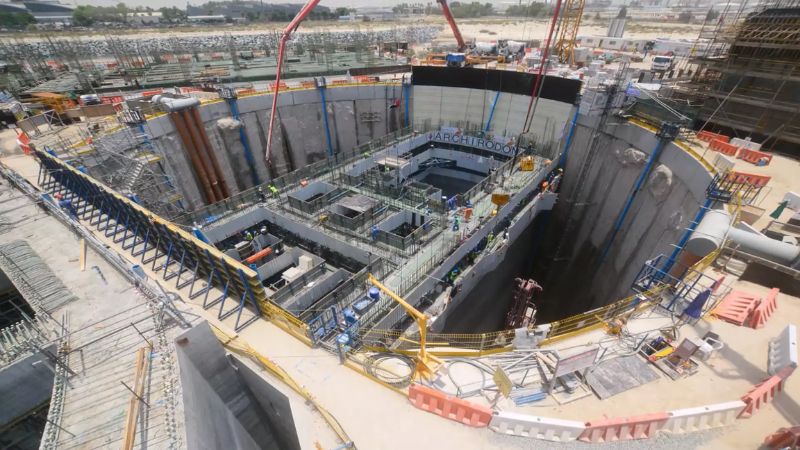
Tasreef is Dubai’s most ambitious stormwater drainage project. DUBAI MUNICIPALITY
Dubai’s rapid recovery from recent heavy rainfall — with flooded roads cleared in less than 24 hours — has once again highlighted the emirate’s growing focus on long-term flood protection through the Dh30 billion Tasreef programme. Tasreef is Dubai’s most ambitious stormwater drainage project to date, designed to protect the city from extreme rainfall events for the next 100 years. The programme aims to increase the emirate’s rainwater drainage capacity by 700 per cent, allowing infrastructure to handle more than 20 million cubic metres of water per day once fully completed. The project was fast-tracked following the record rainfall of April 2024, when the UAE experienced its heaviest rain in 75 years. Since then, Dubai has intensified efforts to upgrade drainage systems, combining deep-tunnel infrastructure with smart monitoring and rapid-response coordination. A major milestone was recently achieved with the completion of a Dh277 million sewerage and rainwater drainage network in Nad Al Sheba 3. The project spans 24 kilometres and includes an advanced pumping station capable of handling 4,000 litres of water per second, supported by a 31-kilometre gravity-based drainage pipeline. “This project is part of Dubai Municipality’s strategic efforts to develop world-class infrastructure that keeps pace with Dubai’s ambitions for global leadership and urban sustainability,” said Marwan Ahmed bin Ghalita, Director General of Dubai Municipality. “It ensures the emirate’s readiness to face future climate challenges for the next 100 years.” Tasreef builds on earlier drainage projects launched in 2019, including systems serving Expo City Dubai, Al Maktoum International Airport City, and Jebel Ali. Future phases will cover key areas such as Dubai International Airport, Al Quoz, Zabeel, Jumeirah, Garhoud, and Al Badaa. The programme also integrates artificial intelligence, Geographic Information Systems, and a Joint Flood Management Room operated from Dubai’s Enterprise Command and Control Centre. These tools allow authorities to monitor rainfall, manage traffic, and respond quickly during severe weather. Climate researchers have warned that extreme rainfall events are becoming more likely due to climate change. “Our cities are not designed to absorb these volumes of water,” said Dr Diana Francis of Khalifa University, whose research highlights the need for better drainage and greener urban planning. Once completed by 2033, Tasreef is expected to significantly reduce surface flooding, protect infrastructure, and ensure Dubai remains resilient in the face of future climate-related challenges. ICA/Expat MediaFor all the latest news from the UAE and the world, follow us on Facebook, Twitter and Instagram and subscribe to our YouTube page










Comments
Leave a Comment