
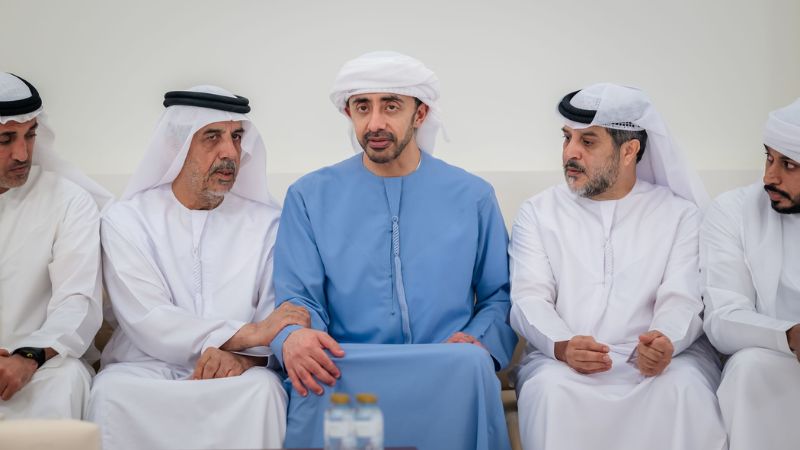
UAE Deputy Prime Minister and Minister of Foreign Affairs Sheikh Abdullah bin Zayed Al Nahyan during the mourning majlis for Captain Pilot Saeed Rashid Al Balushi in Al Ain on March 11, 2026. WAM
The UAE has identified six civilian victims who lost their lives during recent attacks linked to Iran, as officials extended condolences and reaffirmed the country’s security readiness. According to authorities, the victims were Alaa Nader Awni from Palestine; Murib Zaman Nizar, Muzaffar Ali Ghulam, and Ismail Salim Khan from Pakistan; Ahmed Ali from Bangladesh and Dibas Shrestha from Nepal. The total death toll in the UAE has reached eight, including two members of the UAE Armed Forces who died in a helicopter crash on March 9. Captain Pilot Saeed Rashid Al Balushi and First Lieutenant Ali Saleh Ismail Al Tunaiji were martyred "while performing their duties", authorities said. Authorities said the fatalities occurred over a period of more than two weeks amid continued aerial threats since Iranian aggression began on February 28. The first death was recorded on February 28, when a Pakistani national died when debris from an intercepted drone fell on a residential area in Abu Dhabi. Another Pakistani national was killed after shrapnel from an intercepted aerial threat hit his vehicle in Dubai’s Al Barsha area on March 7. On March 16, Awni died after a missile struck his vehicle in Abu Dhabi’s Al Bahyah area. Nepali security guard Shrestha, 29, was killed during a drone attack at Zayed International Airport on March 1. Other victims died after debris from intercepted threats struck their locations, authorities said. UAE Deputy Prime Minister and Minister of Foreign Affairs Sheikh Abdullah bin Zayed Al Nahyan expressed his sympathy to the victims’ families and their home countries. He also wished a swift recovery for those injured. Since February 28, a total of 158 people have been injured, with their injuries ranging from minor to moderate and severe. The injured included nationals of the UAE, Egypt, Sudan, Ethiopia, Philippines, Pakistan, Iran, India, Bangladesh, Sri Lanka, Azerbaijan, Yemen, Uganda, Eritrea, Lebanon, Afghanistan, Bahrain, Comoros, Türkiye, Iraq, Nepal, Nigeria, Oman, Jordan, Palestine, Ghana, Indonesia, Sweden and Tunisia. “The UAE strongly condemns this ongoing escalation targeting civilians and critical facilities across the country,” Sheikh Abdullah said.He described the attacks as a serious violation of the country’s sovereignty and a threat to regional and international stability. Sheikh Abdullah said the attacks have continued for more than two weeks, involving over 2,000 missiles and drones targeting civilian infrastructure, airports, and residential areas. “These unprovoked attacks… have been met with strong international condemnation,” he said, referring to a United Nations Security Council resolution calling for an immediate halt to the attacks. He stressed that the UAE reserves the right to take necessary measures to protect its sovereignty and ensure the safety of all residents. Despite the incidents, officials said the overall security situation in the UAE remains stable. Authorities emphasised that readiness levels are high and that systems are in place to respond to any threats. Sheikh Abdullah also highlighted the support expressed by more than 130 countries, reflecting international confidence in the UAE’s stability and security framework. He reaffirmed the country’s commitment to safeguarding all citizens, residents, and visitors. ICA/WAM/Expat MediaFor all the latest news from the UAE and the world, follow us on Facebook, Twitter and Instagram and subscribe to our YouTube page














Comments
Leave a Comment